In the sixteenth century a small town in Galilee, Safed, became the most vibrant centre of Kabbalah. Scholars and mystics had gathered there, many of them descendants of the Jews expelled from Spain in 1492. Among them was Moses Cordovero, author of a great systematic synthesis of the doctrine of the sefirot. And among them arrived, in the last years of his short life, Isaac Luria, the master who would change the face of Kabbalah.
A master who wrote almost nothing
Isaac Luria, also known by the acronym Ari («the lion»), was born in Jerusalem in 1534 and died in Safed in 1572. His teaching in Safed lasted only a few years, and he left us very little in his own hand.
What we know of his doctrine has reached us mainly through his disciples, in particular Chaim Vital, who gathered and ordered his teachings in vast works, the best known of which is the Etz Chaim, «the Tree of Life». This means that «Lurianic Kabbalah» is, at least in part, also the Kabbalah of Vital.
The starting problem
Every mystical system must answer a question: if God is infinite and fills everything, where is there room for the world? Earlier Kabbalah spoke of emanation: the sefirot radiate from the Infinite as light from a source. Luria proposed a more dramatic answer, articulated in three moments.
First moment: tzimtzum
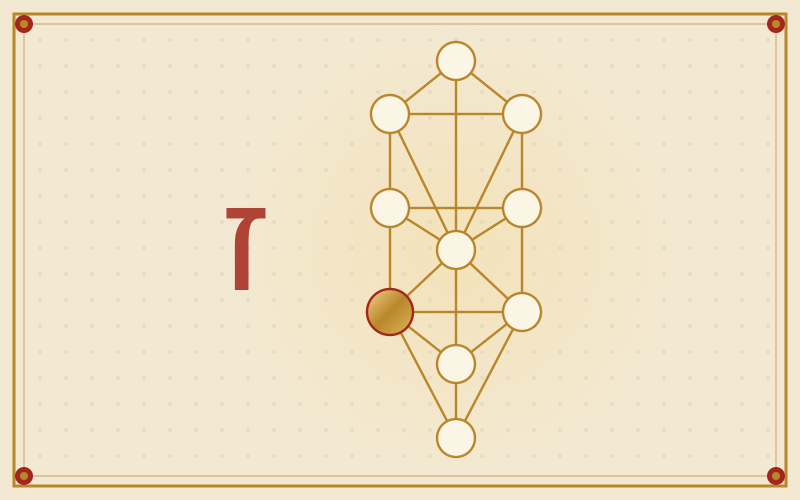
In the beginning, according to Luria, the Ein Sof, the Infinite, filled everything. To create, it does not expand: it withdraws. This contraction is called tzimtzum. The Infinite leaves an empty space free within itself, called tehiru or «primordial space», in which creation can take place.
Into this space a thin ray of light then enters, the kav, the «line», which brings divine light into the void in measured fashion. The first divine act, then, is not a gift but a renunciation: God makes room for what is other than himself.
Second moment: the breaking of the vessels
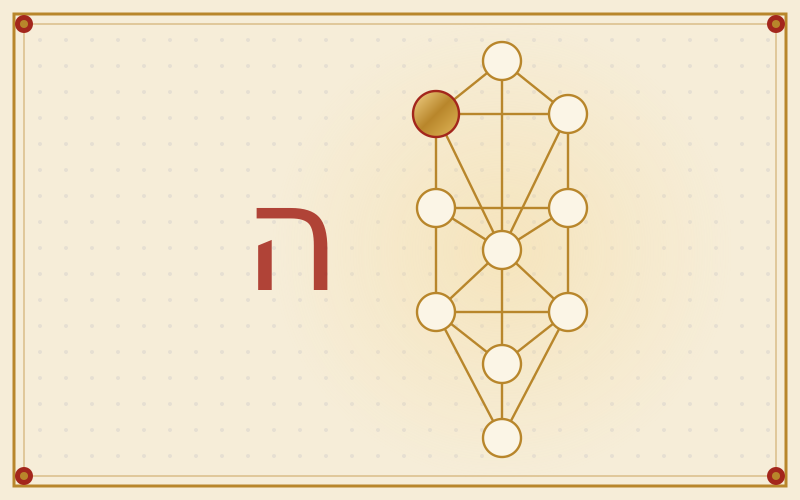
The light entering the empty space has to be received in vessels (kelim), that is, in the structures of the sefirot. The upper vessels hold the light; but the lower ones cannot contain it and shatter. This is the shevirat ha-kelim, the breaking of the vessels.
The consequences are decisive:
- the fragments of the vessels fall downwards, giving rise to the lower worlds;
- part of the light rises back to its source;
- another part remains imprisoned in the fragments as sparks (nitzotzot);
- around the sparks «shells» form, the qelippot, which hide them.
The world, in this vision, did not come out perfect from the Creator's hands. It is a world in which the light is scattered and hidden.
Third moment: tikkun
The third moment is tikkun, repair. The broken structures are reassembled into new configurations, which Luria calls partzufim, «faces»: more stable forms, able to hold the light. But the repair is not carried out from above alone.
Here lies the most original aspect of the doctrine: the human being has an active role. Every righteous action, every prayer made with intention (kavvanah), every gesture performed with awareness frees a spark from its shells and returns it to its source. The history of the world thus becomes a long process of gathering the sparks.
| Moment | Hebrew term | Meaning |
|---|---|---|
| Contraction | tzimtzum | the Infinite makes room for creation |
| Breaking | shevirat ha-kelim | the vessels cannot hold the light and shatter |
| Repair | tikkun | the sparks are gathered and the world is restored |
Luria's legacy
Lurianic Kabbalah had an enormous influence. It gave cosmic meaning to the experience of exile: the divine presence too, like the people, is scattered and waits to be reunited. It inspired new prayers and new rites, such as night vigils of study. It was later an important reference point for Hasidism in the eighteenth century.
The expression tikkun olam, «repair of the world», has over time also had a life of its own outside Kabbalah, as a call to responsibility towards others.
An inner reading
For those who study Kabbalah as a path of inner work, Luria's three moments offer an evocative map. Tzimtzum teaches the value of making room: withdrawing to let the other exist. The breaking of the vessels recognises that crises are part of the structure of life, not an accident. Tikkun reminds us that every gesture, however small, takes part in a greater restoration. Studio Esoterico Cornelio offers these three concepts as themes for meditation, to be deepened over time and not reduced to formulas.
In short
- Isaac Luria (1534-1572) taught in Safed; his doctrine reached us mainly through Chaim Vital.
- Tzimtzum is the contraction of the Infinite that leaves room for creation.
- In the breaking of the vessels the light scatters sparks imprisoned in the qelippot.
- Tikkun is the repair, in which the human being takes part through actions and intentions.
- Lurianic Kabbalah deeply influenced prayer, Hasidism and later thought.