In modern numerology almost every calculation ends with the same operation: reducing a number to a single digit by adding its digits together. But some schools make an exception for three numbers, which they consider too significant to be reduced: 11, 22 and 33. These are the so-called master numbers. Understanding where they come from and what they represent helps to use them with balance, without attributing to them more than the tradition itself claims.
A modern idea
It should be said straight away that the master numbers do not belong to ancient numerology. They are not found in Pythagorean philosophy, nor in traditional Hebrew gematria. They are an elaboration of twentieth-century numerology, developed mainly in the English-speaking world, which later made them popular all over the world.
This does not take away their symbolic value, but it clarifies their nature: they are a convention of a school, not a law of numbers.
Why 11, 22 and 33
The three numbers share one feature: they are made of two identical digits. In this repetition numerology sees an intensification: the base number is, so to speak, doubled.
| Master number | Reduction | Traditional reading |
|---|---|---|
| 11 | 2 | intuition, sensitivity, vision |
| 22 | 4 | construction, the concrete realisation of an ideal |
| 33 | 6 | dedication, care, teaching |
The relationship with the reduction is important: each master number contains the reduced number and carries it to a higher level. 11 is an intensified 2, 22 is a 4 brought to a larger scale, 33 is a 6 lived as service.
11: the threshold
11 is traditionally read as the number that follows the completeness of 10 and goes beyond its limit. Two 1s side by side also evoke the image of two columns, a threshold to be crossed. In modern numerology it is associated with subtle perception and inspiration, but also with a certain inner tension: it is a number that is never satisfied.
22: the builder
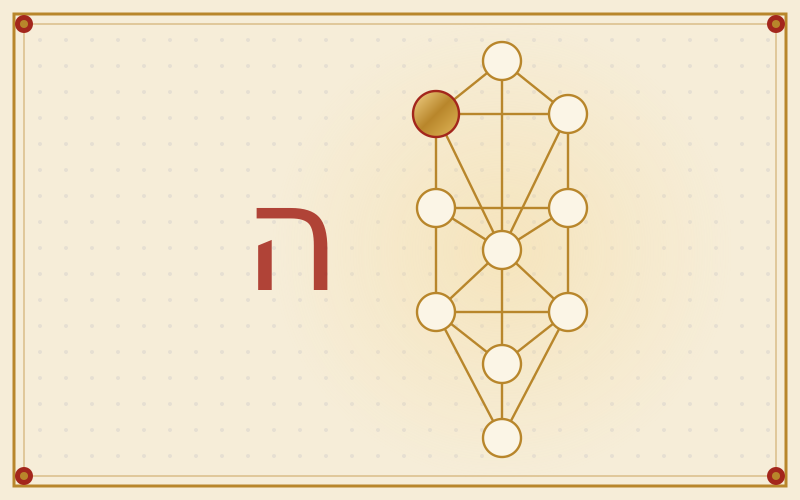
22 has a particularly significant echo for those who study Kabbalah: twenty-two are the letters of the Hebrew alphabet, twenty-two the paths of the Tree of Life and, in the Hermetic tradition, twenty-two the major arcana of the tarot. In the Sefer Yetzirah the twenty-two letters are the tools with which the world is formed.
Modern numerology does not derive directly from Kabbalah, but this coincidence has helped give 22 the image of the builder, the one who translates the ideal into a concrete and lasting form.
33: dedication
33 is the rarest of the three in calculations, and the one on which the schools agree least: some do not even consider it a master number. In Western culture it is full of resonances: according to Christian tradition it is Christ's age at his death; it is the number of cantos in each of the last two canticles of the Divine Comedy, Purgatory and Paradise; it is also the number of degrees of a well-known Masonic rite. Numerology associates it with dedication to others and with teaching.
When master numbers appear
Master numbers appear above all in the calculation of the life path and the name number. The delicate point is that whether they appear depends on the method of calculation: adding the digits in a certain order you may reach 11, while with another procedure you go straight to 2. This is why many numerologists give the result in double form, such as 11/2 or 22/4.
Some schools also extend the idea to 44, 55 and the following numbers formed of two identical digits. It is a minority extension, which shows how much the concept is still under discussion.
A necessary balance
A frequent risk is to regard master numbers as signs of superiority or of a special destiny. The most serious numerological tradition reads them differently: a master number indicates a more intense but also more demanding potential, and its reduction always recalls the base from which to start. Whoever has a 22 also lives the qualities of 4; whoever has an 11 must reckon with the demands of 2.
Studio Esoterico Cornelio suggests approaching the master numbers with this measure: as symbols of an intensity to be understood and integrated, not as titles or promises.
In short
- The master numbers 11, 22 and 33 are an elaboration of twentieth-century numerology.
- They are made of two identical digits and are not reduced in the schools that adopt them.
- Each master number intensifies its reduction: 11 the 2, 22 the 4, 33 the 6.
- 22 recalls the twenty-two Hebrew letters and the twenty-two paths of the Tree of Life.
- They should be read as demanding potentials, not as signs of superiority.