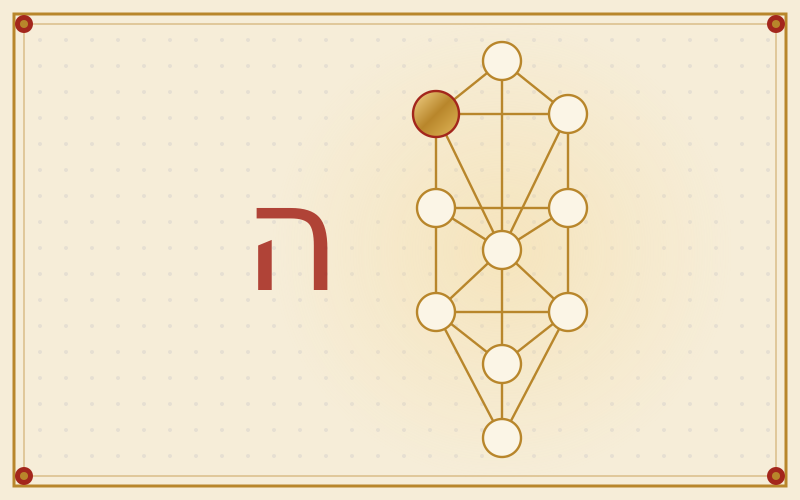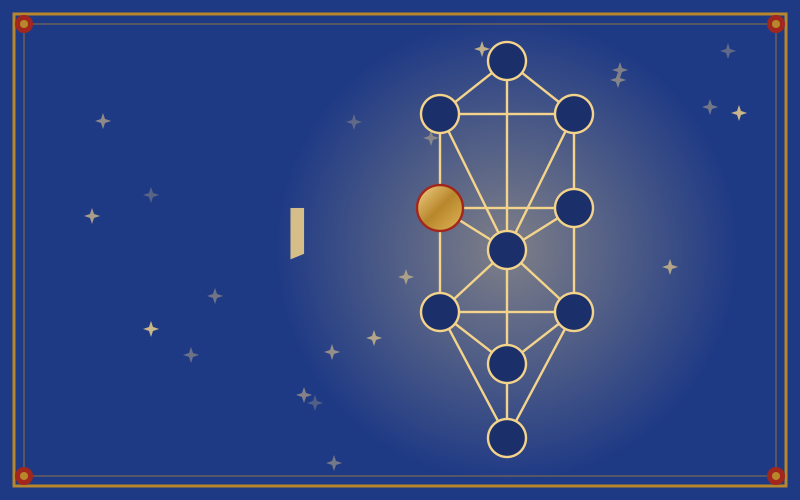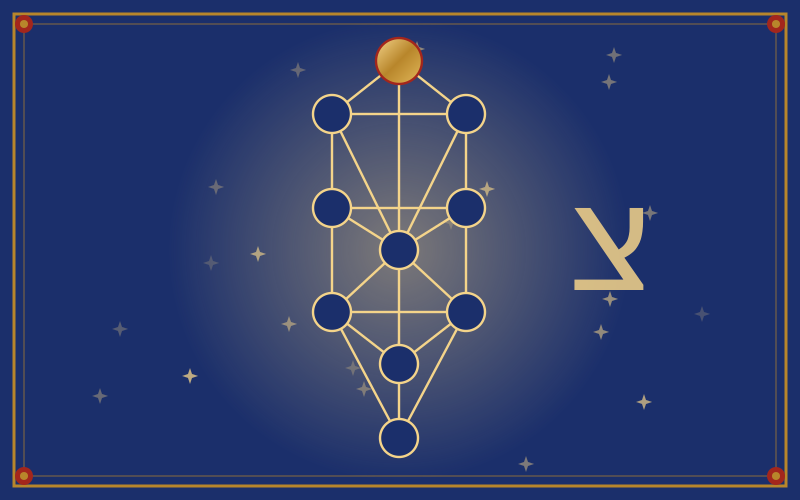
At the base of the Tree of Life, below all the other spheres, lies Malkuth, the Kingdom. It is the tenth and last sefirah, the one in which the process of emanation reaches completion. If Kether is the hidden root, Malkuth is the visible fruit. But it would be a mistake to regard it as the «least important» sefirah: for Kabbalah, Malkuth is the place where the divine becomes present in the world.
The Kingdom with no light of its own
One of the most recurrent images used to describe Malkuth is the Moon. Just as the Moon has no light of its own and reflects that of the Sun, Malkuth has no independent qualities: it receives everything from the higher sefirot, through Yesod, and makes it manifest.
This is why Malkuth is also called aspaklaria she-einah meirah, «the mirror that does not shine with its own light». This is not a lessening: the mirror is precisely what makes light visible.
Another image is that of the vessel or the sea into which all rivers flow. Every energy descending along the Tree arrives here and is gathered here.
The Shekhinah
The most important name of Malkuth is Shekhinah. The word comes from the Hebrew root meaning «to dwell» and in rabbinic literature it refers to the divine presence that dwells among the people: in the Tabernacle, in the Temple, in communities gathered for prayer or study.
Medieval Kabbalah, and the Zohar in particular, developed this idea in an original direction, describing the Shekhinah with feminine features: she is the Queen, the Bride, the Daughter. The central theme is her relationship with Tiferet, the Bridegroom. In this view, the union of Tiferet and Malkuth represents harmony between the transcendent divine and its immanent presence; their separation corresponds to exile and the fragmentation of the world.
The exile of the Shekhinah
A profound theme of the Zohar is that of the Shekhinah in exile. When the people of Israel were scattered, the tradition says, the Shekhinah went with them. The divine presence thus shares the condition of those who are far from home. The human task, through one's actions, is to help reunite the Shekhinah with her Bridegroom.
Names and correspondences
| Field | Correspondence |
|---|---|
| Number | 10 |
| Pillar | base of the middle pillar |
| Divine name | Adonai |
| Biblical figure | King David |
| Day | the Sabbath |
| Hermetic association | the Earth and the four elements |
| Hermetic colours | citrine, olive, russet and black |
David and the Kingdom
The biblical figure associated with Malkuth is David, the king par excellence. It is significant that the tradition links the sefirah of the Kingdom to a king who is also a poet and the author of the Psalms: the kingdom of Malkuth is not power as domination, but the capacity to give concrete and ordered form to what one receives.
The Sabbath Queen
In Jewish tradition the Sabbath is welcomed as a queen or a bride. In Safed, in the sixteenth century, the Kabbalists would go out into the fields at sunset on Friday to greet her. To that milieu belongs the hymn Lekha Dodi, composed by Shlomo Alkabetz, which invites: «Come, my beloved, to meet the bride». The Bride is the Shekhinah, that is, Malkuth.
The four colours of the Hermetic tradition
In the Western Hermetic tradition, Malkuth is often depicted as a circle divided into four parts, with four colours corresponding to the four elements. This choice emphasises that the Kingdom is the world of matter and of the combination of the elements.
It is a later reading, proper to Hermeticism, but consistent with the Hebrew meaning of Malkuth as the place of concrete manifestation.
Malkuth as inner work
What does it mean, in a person's life, to work on Malkuth? The tradition offers some practical pointers:
- Caring for the body and for one's space. Malkuth is the concrete world: keeping the home in order, looking after one's health, paying attention to everyday gestures all belong to this sefirah.
- Bringing things to completion. Many intuitions remain suspended at the higher levels; Malkuth is where they are realised. Finishing a task you have begun is an act of Malkuth.
- Receiving. Malkuth teaches the capacity to welcome, without claiming to generate everything from oneself.
The Studio Esoterico Cornelio often stresses that the esoteric path does not consist in withdrawing from the world, but in inhabiting it with greater awareness. In this sense Malkuth is not a starting point to leave behind, but the place where every path is put to the test.
In short
- Malkuth, the Kingdom, is the tenth sefirah, at the base of the middle pillar.
- Like the Moon, it has no light of its own and manifests what it receives from the higher sefirot.
- It is identified with the Shekhinah, the divine presence in the world, described as Queen and Bride.
- It corresponds to the Name Adonai, King David, the Sabbath and, in Hermeticism, the four elements.
- Inwardly it is the work of completion, care for the concrete and the capacity to receive.