At the top of the Tree of Life, above every other sphere, stands Kether, the Crown. It is the first of the ten sefirot and, at the same time, the one the Kabbalistic tradition speaks of with the greatest caution. Everything that follows on the Tree descends from it, yet Kether itself remains almost inaccessible: it is the point where the infinite begins to become thinkable, without yet being thought.
Why a crown
A crown is not part of the body. It rests above the head, rises over it, frames it. This is the meaning of the image the Kabbalists chose: Kether is not the mind, not the will as a faculty, not one attribute among others. It is what stands above the mind, the source from which the mind receives its first impulse.
This is why many schools describe Kether as primordial will (in Hebrew ratzon) or as a pure desire to become manifest, still without content. Before knowing what one wants, there is the simple fact of wanting. Before form, there is the impulse towards form.
The names of Kether
Kabbalistic literature gives Kether many titles, each highlighting a different aspect:
- Ehyeh, «I will be» or «I am», the divine Name taken from the answer given to Moses at the burning bush (Exodus 3:14). It is the name of a being not yet defined by any quality.
- Atik Yomin, «the Ancient of Days», an expression drawn from a vision in the Book of Daniel.
- Arikh Anpin, «the Long Face» or «the Patient One», a name the Zohar uses for the aspect of Kether turned towards the world.
- Ayin, «Nothingness», not because Kether is empty, but because nothing definable can be attributed to it.
- Nekudah rishonah, «the first point», the beginning without extension from which every line unfolds.
This multiplicity of names is not inconsistency. It expresses how hard it is to say anything precise about what comes before all distinction.
Kether and the Ein Sof
Beyond Kether, Kabbalah places the Ein Sof, «the Without End», the absolute infinite that is not even a sefirah. Kether is the threshold between the two: on one side it is still so close to the infinite that it merges with it, on the other it is already the first degree of emanation.
Some commentators, particularly in the Lurianic school and in Hasidism, go so far as to leave Kether out of the count of ten sefirot, putting Daat, Knowledge, in its place. The reason is precisely this threshold character: Kether belongs more to the origin than to the structure.
Its place on the Tree
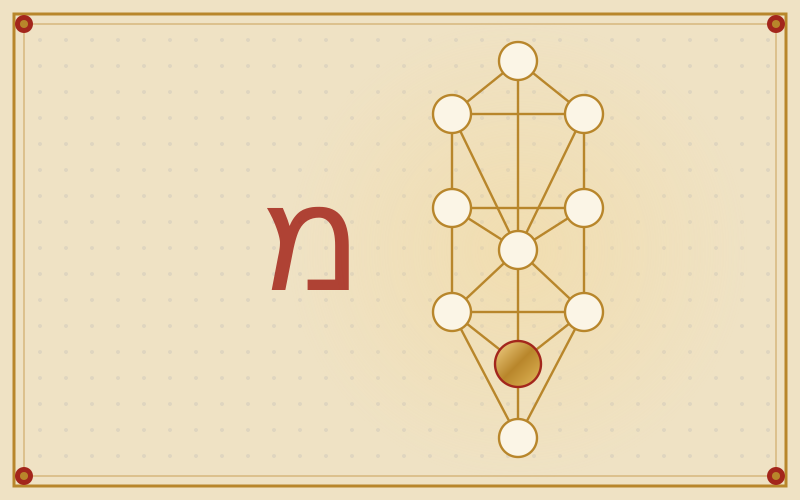
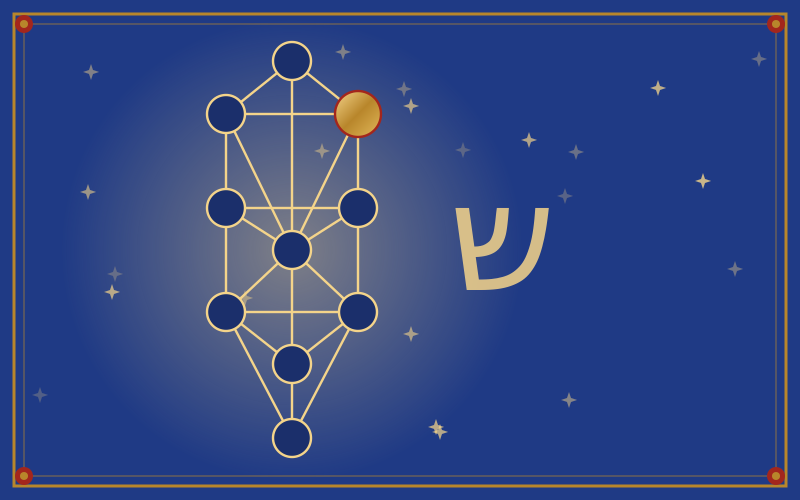
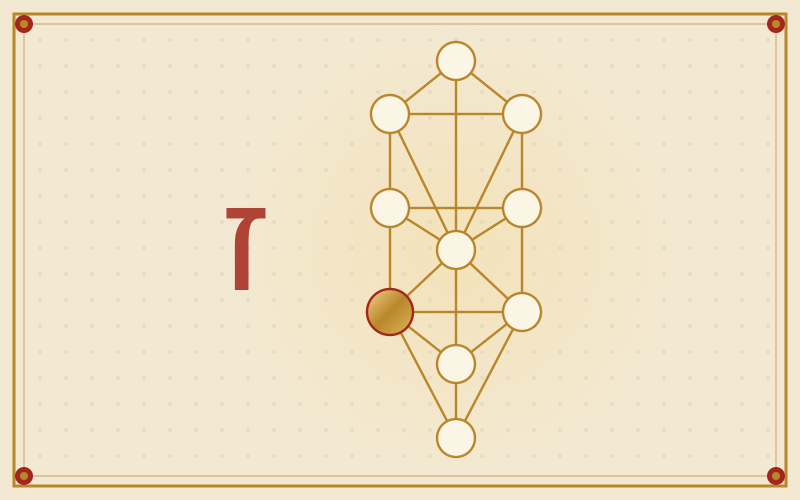
In the classic diagram of the Tree of Life, Kether sits at the top of the middle pillar, also called the pillar of balance. Below it open the two upper sefirot, Chokmah on the right and Binah on the left, which together with Kether form the supernal triad.
Three paths leave Kether:
- towards Chokmah, Wisdom, which receives the first flash;
- towards Binah, Understanding, which will give shape to that flash;
- towards Tiferet, Beauty, through the middle pillar and the hidden space of Daat.
This arrangement shows that Kether is not an isolated summit: it is the point from which energy divides into polarities and from which, along the central axis, it descends to the heart of the Tree.
Correspondences in the Hermetic tradition
Jewish Kabbalah and the Western Hermetic tradition do not coincide, but the latter has built many correspondences on the former. In the Hermetic reading, Kether is associated with:
| Field | Traditional correspondence |
|---|---|
| Number | 1, unity |
| Heaven | the Primum Mobile, the sphere that sets the others in motion |
| Colour | white, light not yet divided |
| Image | an ancient king seen in profile |
| Symbols | the point, the crown, the vortex |
These associations should be read as symbolic language and not as a single doctrine: different authors offer variants, and it is worth knowing which school each one comes from.
Kether as inner experience
If the sefirot are also a map of inner life, what corresponds to Kether in a person's experience? The tradition suggests a few cautious answers.
Kether is the moment that precedes the word. Anyone who meditates knows the instant when the mind grows quiet, there is no image or thought yet, and still there is presence. It is also the point of origin of deep choices: not everyday decisions, but the underlying orientation that gives a life its direction without ever being fully explained.
At the Studio Esoterico Cornelio a simple exercise is often suggested: sit in silence and observe the passage between mental emptiness and the first thought that appears. The aim is not to obtain anything, but to notice that every content of consciousness arises from a space that in itself has no content. It is a concrete way to approach the symbol of the Crown.
Common misreadings
Two misunderstandings come up often:
- Thinking of Kether as a goal to be reached. In the tradition the Crown is not conquered: it is present from the start, as the spring is present in every drop of the river.
- Reducing it simply to «God». Kabbalists carefully distinguish the Ein Sof, which remains transcendent, from the sefirot, which are its manifestations. Kether is the first manifestation, not the infinite itself.
In short
- Kether, the Crown, is the first sefirah and the top of the middle pillar of the Tree of Life.
- It represents primordial will and the impulse to manifest that precedes every form.
- Its names include Ehyeh, Atik Yomin, Arikh Anpin and Ayin, Nothingness.
- It is the threshold between the Ein Sof and the structure of the sefirot; some schools replace it with Daat in the count.
- Inwardly it corresponds to the silent space from which thought and deep orientation arise.