Anyone entering an old mosque, an Andalusian palace or a madrasa in Central Asia finds themselves surrounded by surfaces entirely covered with geometric patterns: interlacing stars, repeating polygons, bands that run on without ever breaking. It is one of the richest traditions of applied geometry humanity has produced. Behind the beauty of the designs lies a rigorous method, and behind the method a spiritual idea.
Why geometry
In Islamic religious spaces the depiction of human and animal figures is generally avoided. This did not impoverish the art but steered it towards three main languages: calligraphy, which gives visible form to the sacred word; the arabesque, with its stylised plant motifs; and geometry, which builds abstract figures of great complexity.
Geometry lent itself particularly well to expressing a central idea of the Islamic faith: tawhid, the oneness of God. A pattern that springs from a single circle and extends endlessly in every direction suggests an order that embraces everything and that no limited surface can contain.
It all begins with the circle
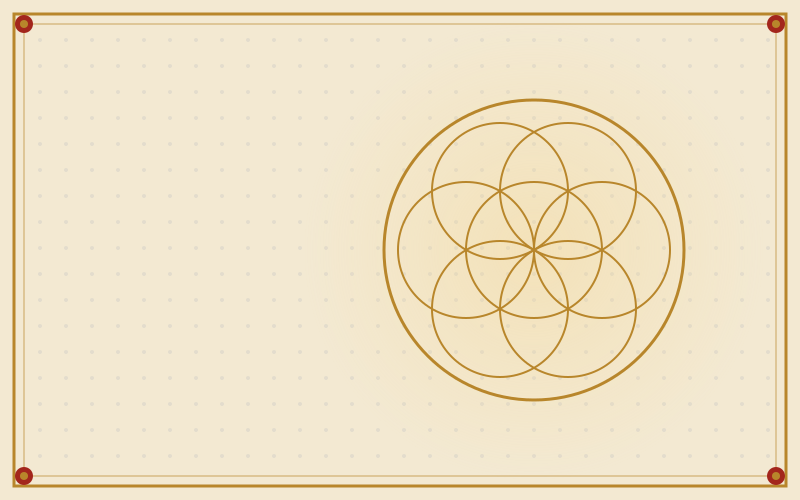
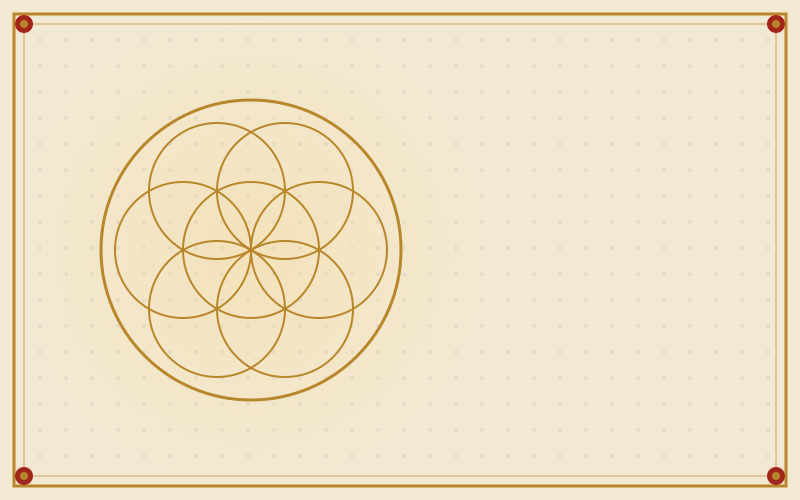
Islamic geometric patterns are built with two tools: the compass and the straightedge. The starting point is almost always a circle, divided into equal parts.
- Dividing the circle into six parts gives hexagons and six-pointed stars.
- Dividing the circle into eight parts, with two squares rotated over each other, produces the eight-pointed star, one of the most widespread figures.
- Dividing the circle into ten or twelve parts gives more complex stars, typical of the most refined phases of this art.
Once the basic cell is built, it is repeated on a grid, like a tile. The lines are then extended, interlaced and selected until the stars and polygons of the final design emerge.
Mathematicians and craftsmen
The link between science and decoration was concrete. In the tenth century the Persian mathematician Abu al-Wafa al-Buzjani wrote a work devoted to the geometric constructions needed by craftsmen, with practical procedures for dividing figures and drawing polygons. It bears witness to the dialogue between those who studied geometry and those who put it to work on building sites.
Pattern scrolls used by architects also survive, such as the so-called Topkapı scroll, now in Istanbul, which contains numerous geometric schemes for wall and vault decoration. These documents show that the designs were not improvised but carefully planned and handed down.
Girih
One of the most remarkable developments is girih, a Persian term meaning «knot». Girih patterns are formed by interlacing lines that create ten-pointed stars and irregular polygons. Modern scholars have shown that many of these designs can be built from a small set of tiles of different shapes, including a decagon, a pentagon and a rhombus, on which the lines of the pattern are already drawn.
Some late examples, such as the panels of the Darb-i Imam shrine in Isfahan, show schemes that do not repeat in a simple periodic way and that recall structures studied by mathematics only in the twentieth century. It is an extraordinary example of geometric intuition developed in craft practice.
Muqarnas: geometry in space
Islamic geometry is not limited to flat surfaces. Muqarnas are compositions of small niche-like elements, arranged on several levels, which turn the transition between a wall and a dome into a kind of stalactite or honeycomb. Seen from below, muqarnas ceilings seem to dissolve the mass of stone or wood into a multitude of cells.
A famous example is also found in Italy: the wooden ceiling of the Palatine Chapel in Palermo, made in the twelfth century for the Norman kings by craftsmen of Islamic culture, is decorated with muqarnas and paintings. It is a testimony to Sicily as a meeting place of traditions.
The Alhambra
The Alhambra complex in Granada, built largely by the Nasrid dynasty between the thirteenth and fourteenth centuries, is one of the best-known places for the richness of its geometric patterns. Walls clad in glazed tiles, carved stucco, muqarnas ceilings and calligraphic inscriptions merge into a whole in which geometry becomes atmosphere.
| Technique | Material | Effect |
|---|---|---|
| Mosaic tilework | glazed ceramic | colour and rhythm on the lower walls |
| Carved stucco | plaster | geometric and calligraphic lace on the upper walls |
| Muqarnas | stucco or wood | vaults that seem to melt into cells |
A contemplative gaze
Islamic geometric patterns invite a particular kind of contemplation: the eye finds no point of arrival but moves from one star to another, discovers ever new centres, and notices that the same figure can be read in different ways. Studio Esoterico Cornelio sees in them one of the highest expressions of a truth shared by many traditions: unity manifests itself in multiplicity, and multiplicity, observed with attention, leads back to unity.
In short
- Geometry is, together with calligraphy and the arabesque, one of the main languages of Islamic art.
- The patterns arise from dividing the circle with compass and straightedge, then repeating it on a grid.
- Mathematicians such as Abu al-Wafa wrote works of practical geometry for craftsmen.
- Girih and muqarnas take geometry to great levels of complexity, on the plane and in space.
- Famous examples are found at the Alhambra in Granada, in Isfahan and in the Palatine Chapel in Palermo.