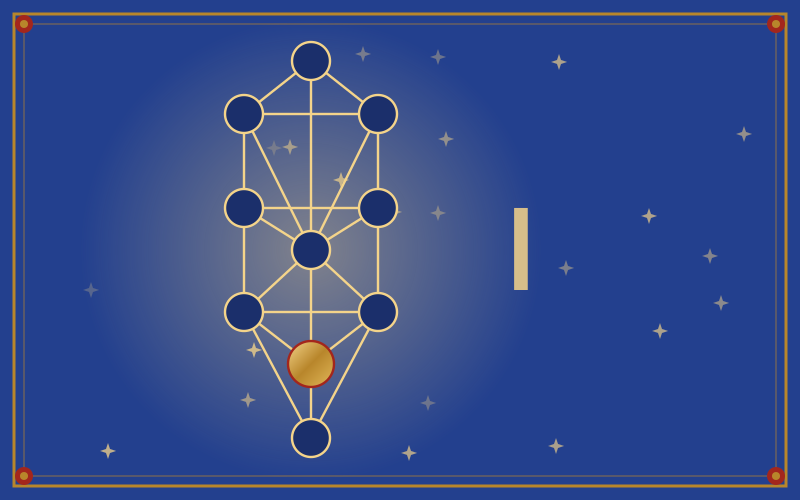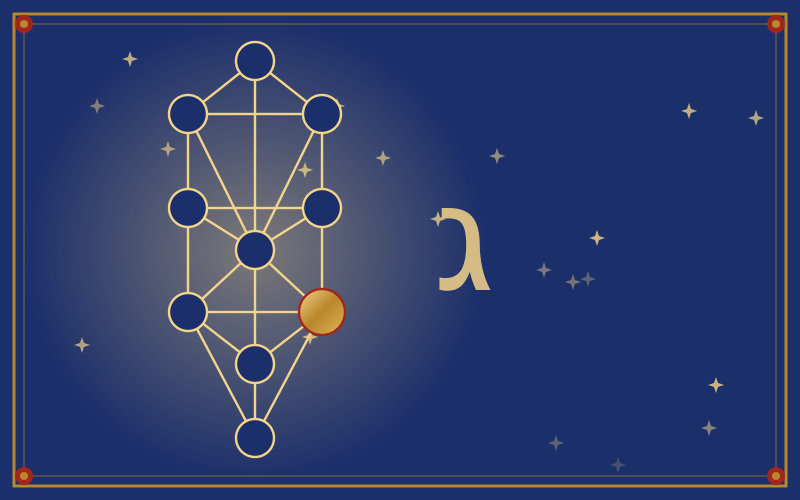
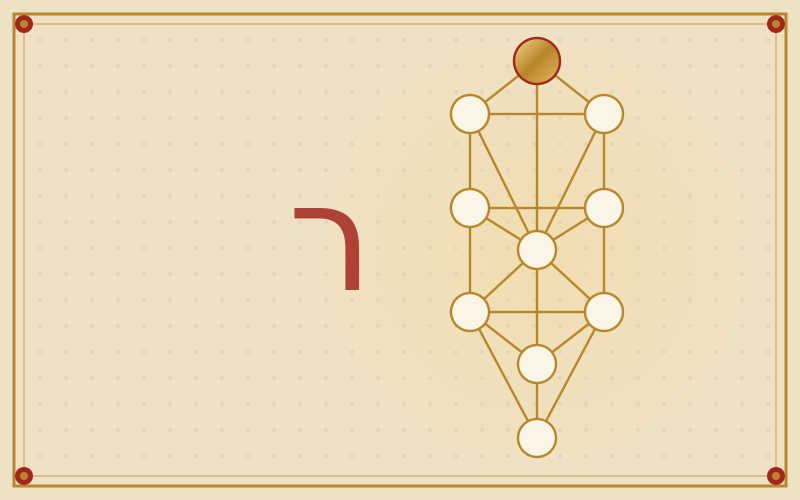
Anyone looking at a diagram of the Tree of Life counts ten circles. Yet many drawings show an eleventh space, dotted or empty, between the supernal triad and the rest of the Tree. This is Daat, Knowledge: a sefirah that is there and is not there, that some schools count and others do not. Understanding why is an excellent way into the logic of Kabbalah.
Ten and not eleven
The Sefer Yetzirah, one of the oldest texts of the tradition, is very clear: the sefirot are «ten and not nine, ten and not eleven». The number ten is not up for discussion. If Daat appears, then, it must do so without altering the count.
Two solutions have been adopted:
- Daat is not an independent sefirah, but the outer aspect or manifestation of another reality, usually Kether. When Kether remains hidden, Daat takes its visible place.
- Daat replaces Kether in the count. This is the choice of part of the Lurianic school and of many Hasidic authors: Kether is considered too close to the Ein Sof to be counted, and the ten sefirot begin with Chokmah, Binah and Daat.
Either way the result is the same: ten sefirot, not eleven.
The biblical roots
The term daat occurs often in the Hebrew Bible. One verse of Proverbs is particularly important for Kabbalah: «The Lord by wisdom founded the earth; by understanding he established the heavens; by his knowledge the depths were broken up».
The three words of the verse are chokhmah, tevunah (from the same root as Binah) and daat. The Kabbalists saw in it the complete intellectual triad: Wisdom, Understanding and Knowledge.
The Genesis story also speaks of Daat: the forbidden tree of Eden is Etz ha-Daat tov va-ra, «the tree of the knowledge of good and evil». This link has had important consequences for the way the Hermetic tradition interpreted the sefirah.
Knowledge as union
The Hebrew verb yada, from which daat derives, means «to know», but in the Bible it also refers to the intimate union of man and woman: «Adam knew Eve». For Kabbalah authentic knowledge is not an accumulation of information but union between the knower and the known.
Daat is therefore described as the point where Chokmah and Binah, the Father and the Mother, meet, and from which their union is passed on to the lower sefirot. A figure often used is the neck, which joins the head to the body and allows the mind's decisions to reach the limbs.
Chabad: Chokmah, Binah, Daat
The Hasidic movement Chabad takes its name precisely from the initials of the three intellectual sefirot: Chokmah, Binah, Daat. In its teaching, Daat has a very concrete meaning: it is the capacity to hold one's attention on an idea until it becomes a conviction that moves feeling and action.
A practical example makes the point clear. One can understand perfectly well that a certain habit is harmful (Chokmah and Binah) and still change nothing. Daat is the moment when that understanding becomes so present that it transforms behaviour. Knowing about something is not enough: one must know it in the full sense.
The abyss in the Hermetic tradition
The Western Hermetic tradition, especially between the nineteenth and twentieth centuries, gave Daat a different interpretation. Daat is placed over the Abyss, the rift that separates the supernal triad from the seven lower sefirot. It is a space of passage, dangerous and decisive, that divides the world of pure ideas from that of manifestation.
In this reading, crossing the Abyss symbolises going beyond ordinary personal identity. Some authors have built complex doctrines around Daat, but these belong to modern Hermeticism and not to traditional Jewish Kabbalah. It is important to keep the two perspectives apart.
| Perspective | What Daat is |
|---|---|
| Sefer Yetzirah | not counted: the sefirot are ten |
| Lurianic Kabbalah and Chabad | an intellectual sefirah, often in place of Kether |
| Modern Hermetic tradition | threshold of the Abyss, the «unmanifest» sefirah |
An awareness exercise
To approach Daat in a practical way, choose a single idea you consider true and important, for example «time spent listening is worth more than time spent talking». For a week:
- Bring it to mind every morning, for a few minutes.
- Link it each day to a concrete episode you lived through.
- At the end of the week, observe whether anything has changed in your behaviour.
This is the kind of exercise the Studio Esoterico Cornelio proposes to show the difference between knowing about something and truly knowing it.
In short
- Daat, Knowledge, appears in many diagrams as a «hidden» sefirah below the supernal triad.
- The Sefer Yetzirah fixes the sefirot at ten; so Daat is either not counted or replaces Kether.
- Its roots are biblical: Proverbs and the tree of knowledge in Eden.
- In Chabad Hasidism it is the capacity to turn understanding into lived conviction.
- Modern Hermeticism places it over the Abyss, an interpretation distinct from Jewish Kabbalah.