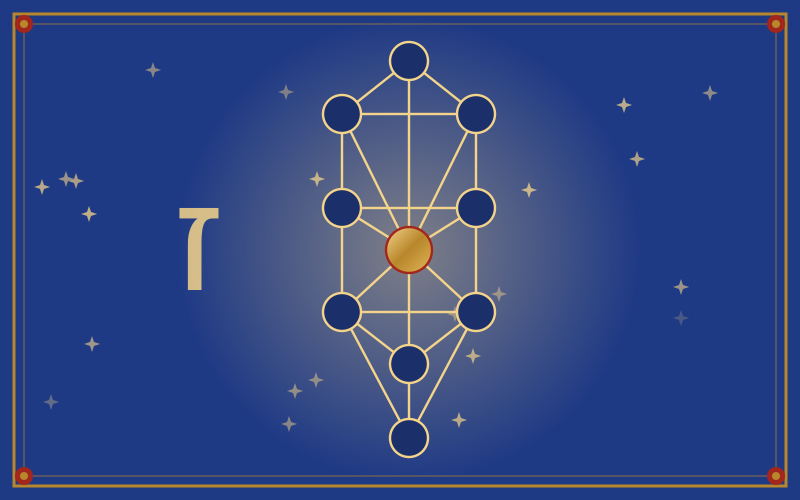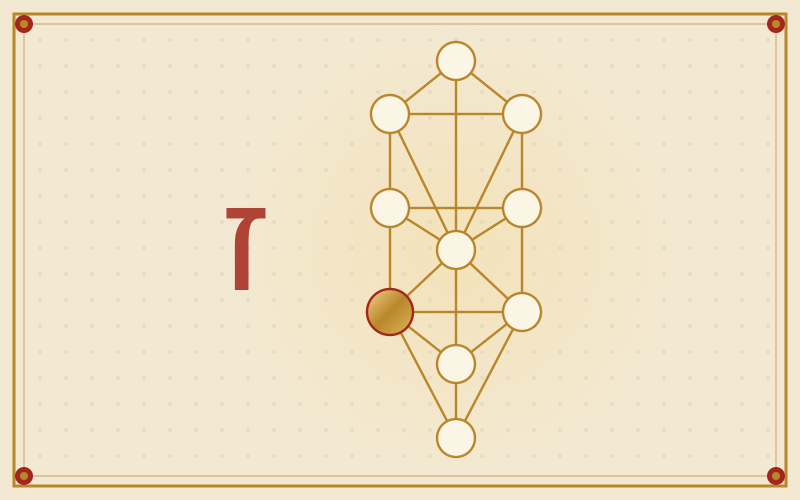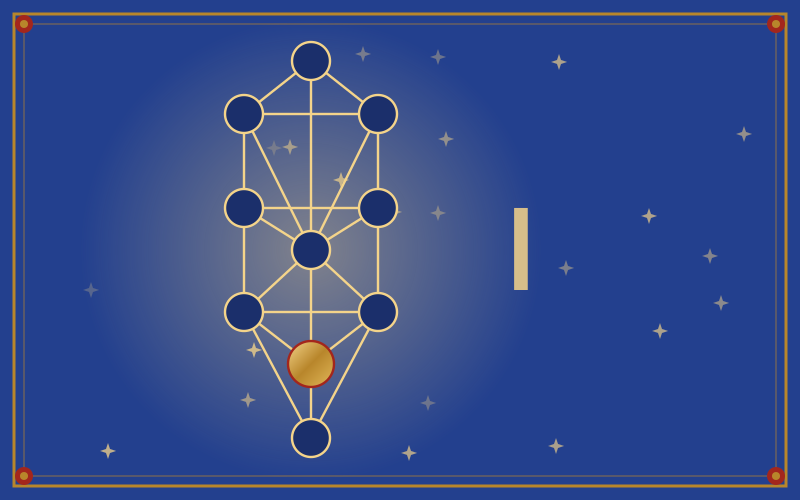
In diagrams of the Tree of Life the highest sefirah is Kether, the Crown. But above Kether, in drawings of the Hermetic tradition, three concentric semicircles often appear, or an area deliberately left empty. It is the place of what cannot be drawn: the Ein Sof, the Infinite. Understanding this concept is essential, because the whole of Kabbalah starts from there.
«Without end»
The Hebrew expression Ein Sof literally means «without end». It is not a name in the usual sense: it is rather a negation, a way of saying what God is not. It has no limits, no boundaries, no attributes that enclose it.
The term became established among the early kabbalists of Provence and Catalonia, in the twelfth and thirteenth centuries. In particular it was used in the circle of Isaac the Blind and by the kabbalists of Girona, such as Azriel, who made it the starting point of their reflection on the sefirot.
A theology of silence
The idea of Ein Sof belongs to a long tradition, shared by many mystical currents, that we would call negative theology: nothing positive can be said of God in himself, because every word would limit him. One can only say what he is not.
This is why in medieval Kabbalah the Ein Sof almost never appears in prayer and is not described through images. It is not the God who speaks in the Torah, who reveals himself, who acts in history: that is the God of the sefirot. The Ein Sof is the hidden root of everything, before any manifestation.
Ein Sof and the sefirot
The problem that occupied generations of kabbalists is the relationship between the Infinite and the sefirot. If the Ein Sof has no attributes, how can the sefirot, which are attributes, come from it?
The traditional answers vary, but certain images recur:
- light and coloured glass: the Ein Sof is like a single light which, passing through panes of different colours, appears in ten hues without changing its nature;
- water and vessels: just as water takes the shape of the vessels into which it is poured, so infinite light shows itself according to the form of the sefirot;
- soul and body: the Ein Sof is to the sefirot as the soul is to the limbs, present in all of them without being identified with any.
Moses Cordovero, in Safed, made wide use of these images to explain that the sefirot are at once instruments and manifestations of the divine.
The three veils of negative existence
In the Western Hermetic tradition, and in particular in the Kabbalah reworked by occultists between the nineteenth and twentieth centuries, the Ein Sof is presented as a succession of three veils preceding Kether:
| Veil | Hebrew | Meaning |
|---|---|---|
| First | Ain | Nothingness |
| Second | Ain Sof | the Infinite, the Endless |
| Third | Ain Sof Aur | the Infinite Light |
In this reading manifestation happens by degrees: from absolute Nothingness one passes to the Infinite, from the Infinite to the Infinite Light, and the Infinite Light finally concentrates into a point, which is Kether. It is an effective teaching scheme, which helps to visualise the passage from the unknowable to the first principle.
It should be said clearly that this arrangement into three veils is typical of the modern Hermetic tradition. Its components have roots in the Jewish sources, which speak of ayin, nothingness, and of or Ein Sof, the light of the Infinite, but the ordering into three successive stages does not belong to classical Kabbalah in the same form.
Nothingness as fullness
One of the deepest ideas linked to the Ein Sof is that of Nothingness. In many kabbalistic texts the first sefirah, Kether, is called ayin, «nothing». Not because it is empty, but because it is so full that it cannot be determined by any quality.
Kabbalists loved to play with the letters of this word: ayin (Aleph, Yod, Nun) and ani, «I» (Aleph, Nun, Yod), are made of the same letters. The passage from Nothing to I is, in this reading, the very movement of creation; and the mystical path is the reverse journey, from the I that believes itself separate to the nothing that contains everything.
How to approach the Ein Sof
The Ein Sof is not an object of study like the other sefirot: it has no correspondences, colours, divine names or angels. The traditional way of approaching this concept is silence. Studio Esoterico Cornelio suggests a simple exercise: before each session of study of the Tree, spend a few minutes contemplating the empty space above Kether, remembering that every symbol of the Tree is a partial reflection of something that remains beyond every symbol.
In short
- Ein Sof means «without end» and indicates the Infinite beyond every attribute.
- The term became established among the kabbalists of Provence and Catalonia in the twelfth and thirteenth centuries.
- The relationship between Ein Sof and the sefirot is explained through images such as light through coloured glass.
- The three veils Ain, Ain Sof and Ain Sof Aur are an arrangement of the modern Hermetic tradition.
- The play between ayin (nothing) and ani (I) expresses the movement of creation and return.