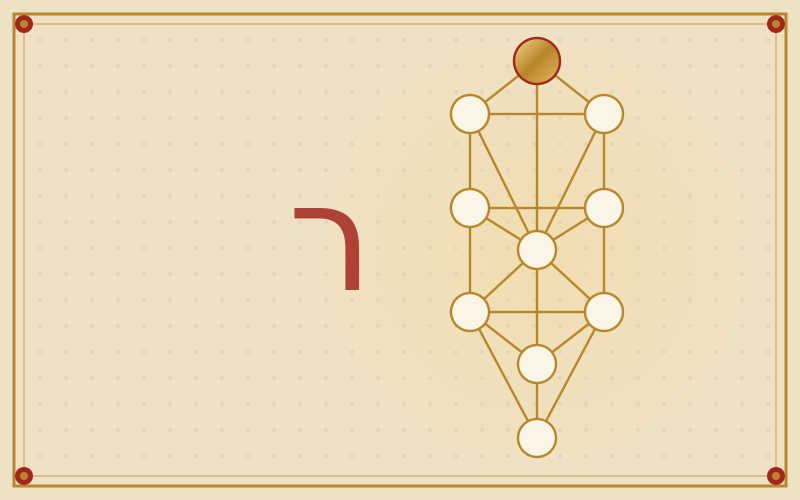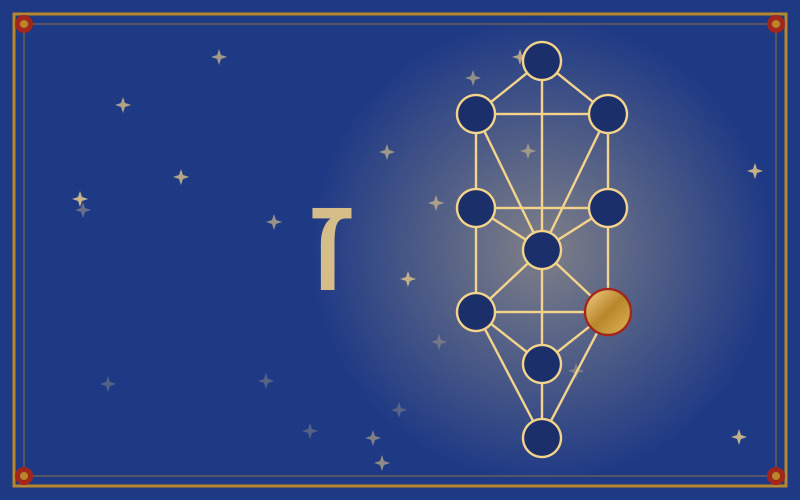
Just below Kether, the Crown, the Tree of Life opens in two. On the right stands Chokmah, Wisdom; on the left Binah, Understanding. They are the second and third sefirot and, together with the Crown, they make up the supernal triad, the highest and most abstract level of the Tree. Understanding them as a pair is essential, because neither makes sense without the other.
The flash and the womb
The tradition describes Chokmah as a flash: a sudden, total intuition, without detail. It is the moment when an idea lights up all at once, before one knows how to explain it. The Zohar also calls it reshit, «beginning», linking it to the first word of Genesis, Bereshit, «In the beginning».
Binah is the womb that receives that flash and gives it shape. It develops, distinguishes, articulates. If Chokmah is the seed, Binah is the soil that welcomes it and lets it grow. The Hebrew root of Binah is the same as that of the word bein, «between»: to understand means to grasp the relations between things, to separate them and connect them.
A concrete example helps. A musician suddenly hears a whole melody in their mind: this is Chokmah. Then they spend hours writing it down, choosing harmonies, deciding the rhythm: this is Binah. Without the first moment there would be nothing to work on; without the second the intuition would remain a glimmer with no sequel.
Father and Mother
In the symbolic language of Kabbalah, Chokmah and Binah are called Abba and Imma, Father and Mother. The Lurianic school, which organises the sefirot into «faces» or partzufim, describes them as two figures who unite to generate the lower sefirot.
This image should not be taken in a biological or social-gender sense. It points to two complementary functions present in every creative process: the impulse that gives itself and the capacity that receives and structures. Every person, in the traditional reading, contains both.
Names and attributes
| Chokmah | Binah | |
|---|---|---|
| Number | 2 | 3 |
| Pillar | right, of Mercy | left, of Severity |
| Divine name | Yah | YHVH read as Elohim |
| Image | the point extending into a line | the palace, the sea |
| Hermetic association | the sphere of the zodiac | Saturn |
| Hermetic colour | grey | black or deep indigo |
The association of Binah with Saturn, typical of the Hermetic tradition, stresses the aspect of limit and form: the structure that contains, time that gives measure. Binah is also called «the sea», from which all forms are born, and is sometimes linked to both the dark mother and the bright mother, because form is at once a limit and a birth.
Why Binah stands on the pillar of Severity
It may be surprising that the Mother stands on the side of Severity, above Gevurah. The reason is logical: giving form means setting boundaries. Every definition excludes something. To say that an object is a table is to say that it is not a chair. Binah is the principle of distinction, and distinction is, in a technical sense, a form of rigour.
Chokmah, by contrast, stands on the pillar of Mercy because it is expansion, a gift without limit. Its energy, left alone, would disperse; Binah's, left alone, would harden. The Tree sets them opposite each other so that they balance.
The path that joins them
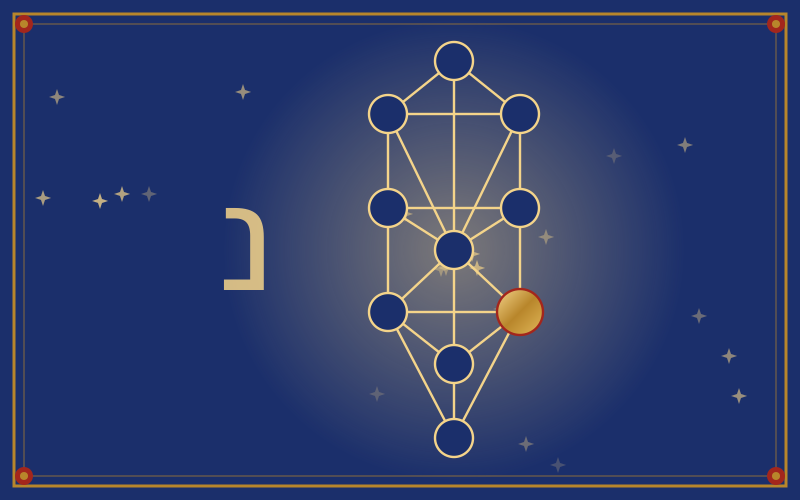
Between Chokmah and Binah runs a horizontal path, the first of the Tree's «transverse» paths. In the Hermetic tradition that assigns Hebrew letters to the paths, the letter given to it varies depending on the scheme adopted; what stays constant is the meaning: it is the channel through which intuition turns into understanding.
Below the two sefirot opens the space of Daat, Knowledge, which many authors describe as the fruit of their union. In Hebrew the verb yada, «to know», is the same one the Bible uses for the union of Adam and Eve: knowledge as intimate encounter, not as a mere accumulation of facts.
A reflective exercise
At the Studio Esoterico Cornelio it is suggested that for a few days you observe your own way of thinking with this pair in mind:
- Note down sudden intuitions, even small ones, the moment they appear.
- Return to them the next day and try to develop them in writing, looking for links and consequences.
- Notice which of the two moments comes more easily and which is more of an effort.
Those who have many ideas and few realisations lean towards Chokmah; those who analyse a great deal and intuit little lean towards Binah. The exercise passes no judgement; it shows a balance to be cultivated.
In short
- Chokmah, Wisdom, is the intuitive flash; Binah, Understanding, is the capacity to give it form.
- They are called Abba and Imma, Father and Mother, and with Kether they form the supernal triad.
- Chokmah stands on the pillar of Mercy, Binah on that of Severity, because giving form means setting limits.
- From their union Daat, Knowledge understood as encounter, is symbolically born.
- Inwardly they represent the balance between intuition and articulated understanding.