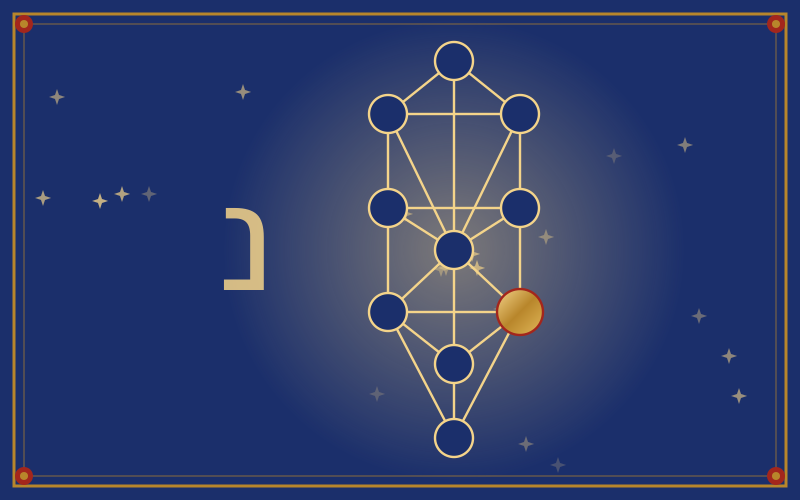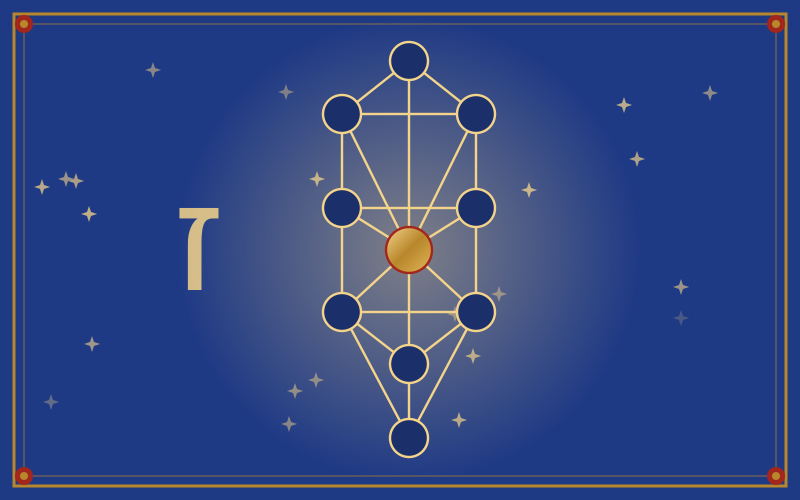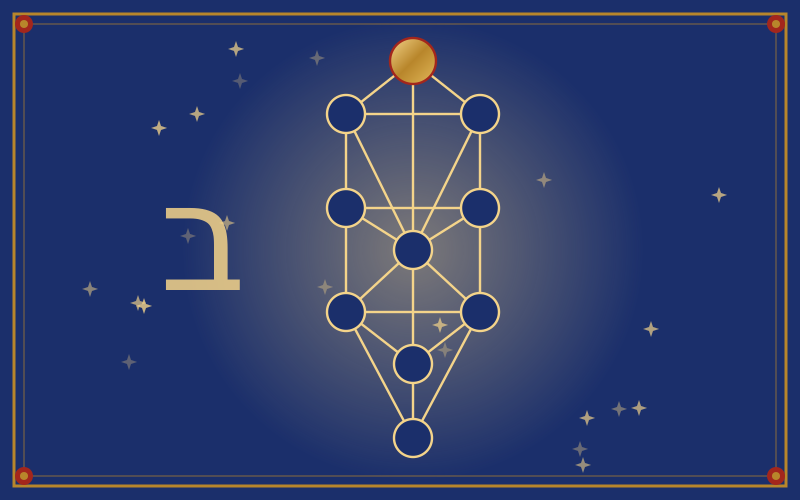
Moving down the Tree of Life, after the supernal triad we meet a second pair of sefirot, closer to human experience. Chesed, Mercy or Grace, stands on the right pillar; Gevurah, Strength or Severity, on the left pillar. They are the fourth and fifth sefirot and describe two fundamental moral movements: giving and holding back, welcoming and setting limits.
Chesed: the open hand
Chesed is love that expands without calculation. The tradition also calls it Gedulah, «Greatness», because it is the quality of one who makes room for others. In the Bible the word chesed means faithful kindness, benevolence that goes beyond what is owed.
The biblical figure associated with Chesed is Abraham, the man of hospitality. The story of the three visitors welcomed under the oak of Mamre, whom Abraham runs to meet in the heat of the day, is the classic image of this sefirah: generosity that does not wait to be asked.
The divine Name of Chesed is El, the simplest and most ancient name, associated with benevolent power. In the Hermetic tradition Chesed corresponds to Jupiter, the planet of magnanimity and abundance, and to the colour blue.
Gevurah: the hand that measures
Gevurah is the capacity to say no, to set a limit, to judge. It is also called Din, «Judgement», and Pachad, «Fear». It is not cruelty: it is the strength needed so that goodness does not turn into chaos.
The biblical figure associated with Gevurah is Isaac, the son bound on the altar in the story of the Akedah. Isaac represents discipline, reverent awe, acceptance of limits. The divine Name is Elohim, the name that in Genesis accompanies creation by separation: light and darkness, upper and lower waters.
In the Hermetic tradition Gevurah corresponds to Mars and to the colour red, symbols of energy, courage and a clean cut.
Why both are needed
Kabbalah insists on one point: neither quality is good on its own.
| Imbalance | Symbolic effect |
|---|---|
| Chesed without Gevurah | smothering generosity, permissiveness, no boundaries |
| Gevurah without Chesed | harshness, merciless judgement, rigidity |
| Both in balance | Tiferet, Beauty, standing in the centre |
An everyday example is raising a child. A parent who is only affectionate and never sets rules does not help the child grow. A parent who is only strict frightens them. What is needed is a love capable of limits and a rigour born of love.
An ancient midrash on Genesis expresses this idea with a powerful image: the world could not have endured had it been created with Judgement alone, nor with Mercy alone. This is why the Tree places the two sefirot opposite each other, joined by a horizontal path.
The origin of evil in the Kabbalistic reading
A delicate aspect of Gevurah concerns the problem of evil. Several Kabbalistic texts hold that evil arises when Severity separates from Mercy and acts alone, with no balance left. Evil, in this view, is not an autonomous principle opposed to good, but a good force that has lost its counterweight.
It is an idea that invites personal reflection: many harmful actions spring from legitimate qualities, such as justice, firmness, defending one's boundaries, pushed to excess and cut off from all compassion.
The seven lower sefirot and the days
Chesed opens the series of the seven lower sefirot, which an ancient tradition links to the seven days of creation. Chesed corresponds to the first day, that of light; Gevurah to the second, that of the separation of the waters.
During the period of the Omer, the forty-nine days that in the Jewish calendar separate Passover from Shavuot, the Kabbalistic tradition proposes meditating each day on a combination of two sefirot: «Chesed within Chesed», «Gevurah within Chesed» and so on, seven by seven. It is an example of how the Tree has also been used as a tool of inner discipline.
A practical exercise
A simple reflective practice is to review your day in the evening with two questions:
- Where did I give more than was helpful, giving up a necessary limit?
- Where was I rigid when understanding was needed?
Writing down the answers for a few weeks lets you see your dominant tendency. Maestro Cornelio often uses this pair of questions as a starting point for the study of the sefirot: not as a moralising examination of conscience, but as the observation of two forces everyone carries within.
In short
- Chesed, Mercy, is love that expands; Gevurah, Severity, is the strength that sets limits.
- Chesed is associated with Abraham, the Name El and Jupiter; Gevurah with Isaac, the Name Elohim and Mars.
- Neither is good on its own: their balance gives rise to Tiferet, Beauty.
- For many Kabbalists evil arises from Severity separated from Mercy.
- The counting of the Omer shows the traditional use of the sefirot as inner discipline.