Few concepts have travelled through the history of thought like the golden ratio. It was born as a problem of pure geometry, became the «divine proportion» of the Renaissance and is now quoted everywhere, often inappropriately. To truly understand it, it is best to start from the definition, separate what can be proven from what is legend, and only then ask why the esoteric tradition saw in it a symbol of harmony between the parts and the whole.
The definition: dividing a line in extreme and mean ratio
In the sixth book of the Elements, Euclid describes how to divide a line segment «in extreme and mean ratio». The idea is to cut a line into two unequal parts so that the ratio of the whole to the larger part equals the ratio of the larger part to the smaller.
This ratio is a precise number, now written with the Greek letter φ (phi):
- φ = (1 + √5) / 2, roughly 1.618;
- its reciprocal is roughly 0.618, and is exactly φ − 1;
- its square is roughly 2.618, and is exactly φ + 1.
No other positive number has this property: adding one is the same as squaring, subtracting one is the same as turning it upside down. It is a number that generates itself, and this alone partly explains the fascination it has exerted.
How to construct it with ruler and compass
The golden ratio needs no calculation: it is drawn. A classic procedure for a golden rectangle goes like this:
- draw a square;
- find the midpoint of one of the base sides;
- place the compass point there and open it to one of the opposite corners;
- draw an arc down to the extension of the base;
- close the rectangle: its sides are in the golden ratio.
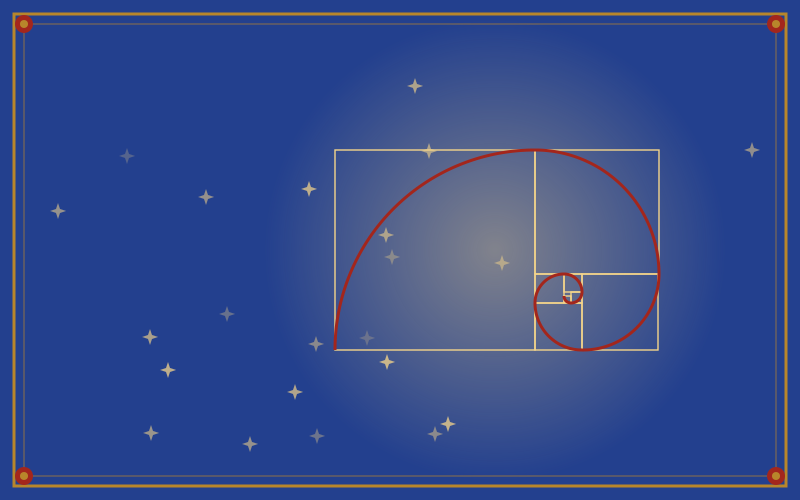
The resulting rectangle has a remarkable property: remove the original square and what remains is again a golden rectangle, only smaller. Repeating the operation produces an endless sequence of squares and rectangles winding towards a point, the basis of the so-called golden spiral.
The pentagon, the true home of the golden number
The geometric figure in which the golden ratio appears most naturally is the regular pentagon. The ratio between a pentagon's diagonal and its side is exactly φ. The diagonals cross to form the five-pointed star and cut one another in the same proportion; at the centre a new, smaller, inverted pentagon appears, in which everything repeats.
It is precisely this recursion, the fact that the figure contains endless copies of itself, that suggested to ancient and medieval thinkers the image of an order mirrored at every level.
Luca Pacioli and the «divine proportion»
The name under which the golden ratio entered European culture comes from the friar and mathematician Luca Pacioli, who in 1509 published in Venice the treatise De divina proportione, illustrated with drawings of polyhedra by Leonardo da Vinci. Pacioli called this proportion divine for theological reasons: just as God is one and three, the proportion binds three terms into a single relation; just as God cannot be fully defined, the number cannot be expressed as an exact fraction.
The expression «golden section», on the other hand, is far more recent and only spread in the nineteenth century.
What is true and what is legend
A modern mythology has grown around the golden number, and it deserves rigorous treatment. Many oft-repeated claims do not survive careful measurement:
| Common claim | Assessment |
|---|---|
| The regular pentagon contains φ | True, provable |
| The Fibonacci sequence tends towards φ | True, provable |
| The Parthenon was designed on the golden ratio | Not proven |
| Every beautiful face follows φ | Not proven |
| All spiral shells are golden | False in most cases |
A rectangle with proportions close to 1.6 may look golden, but close is not equal, and on a monument one can choose measurements so as to obtain almost any ratio. The serious student of sacred geometry has no need to force the data: the symbolic value of the proportion does not depend on its appearing everywhere.
The symbolic meaning
In the traditional reading cultivated by Studio Esoterico Cornelio, the golden ratio is above all an image of harmonious relationship. The whole is to the larger part as the larger part is to the smaller: what is great and what is small speak the same language. It is the geometric translation of the ancient Hermetic principle that what is below corresponds to what is above.
There is also a second, subtler teaching. φ is an irrational number: it never lets itself be closed into a final fraction. It can be approximated ever more closely, but never wholly possessed. In this sense it represents well the inner path, which advances by successive approximations towards a centre that is never reached once and for all.
In short
- The golden ratio divides a line so that the whole is to the larger part as the larger is to the smaller; the ratio is about 1.618.
- It is constructed with ruler and compass from a square and finds its most natural expression in the regular pentagon.
- The name «divine proportion» comes from Luca Pacioli and his 1509 treatise illustrated by Leonardo.
- Many appearances attributed to the golden number in art and nature are unproven and should be checked.
- Symbolically it expresses the correspondence between parts and whole, and a path that advances by approximation.