Among the most recognisable features of medieval cathedrals is the rose window: a large circular window, usually set in the façade or at the ends of the transept, divided by a web of stone into petals, spokes and smaller circles. From outside it looks like stone embroidery; from inside, when the sun shines through it, it becomes a wheel of colours suspended in the darkness of the nave. It is one of the places where medieval sacred geometry becomes most visible.
From oculus to rose
The rose window grows out of a simpler form: the oculus, a round window without divisions, already present in Roman and early Christian architecture. In the Romanesque period the oculus begins to be subdivided by small columns arranged radially, like the spokes of a wheel. In the Gothic period the tracery multiplies and becomes more refined, until it creates compositions of great complexity.
In Italian the form is called rosone, from its resemblance to an open flower; in other languages too one speaks of a «rose window». Before becoming a rose, however, it was for a long time a wheel.
Dividing the circle
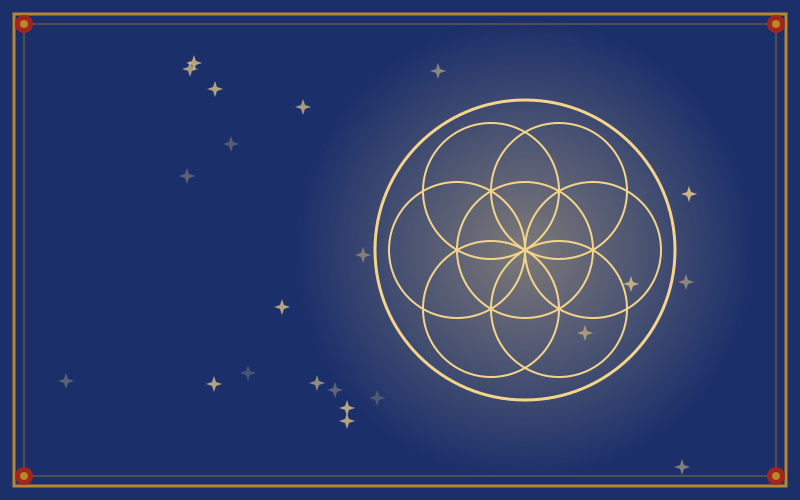
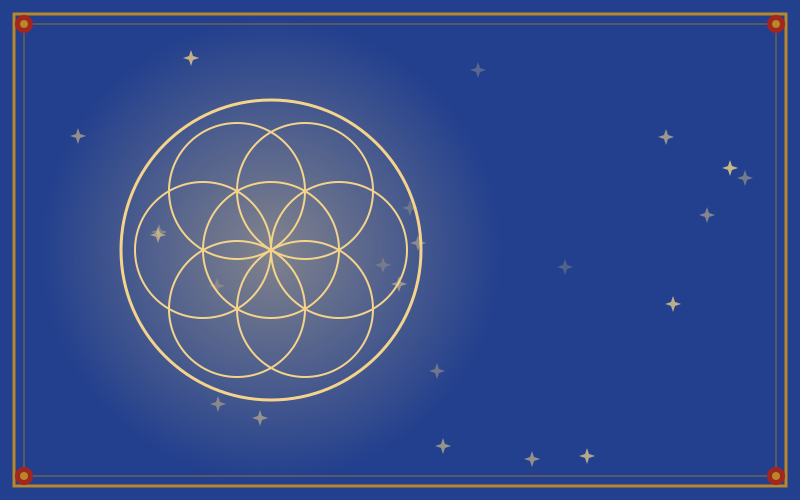
Building a rose window always starts from a geometric operation: dividing the circle into equal parts. With a compass alone some divisions are easy to obtain:
- The circle's radius, stepped around the circumference, divides it exactly into six parts.
- Halving each arc gives twelve parts.
- Drawing two perpendicular diameters and their bisectors gives four, eight and sixteen parts.
This is why many rose windows are based on multiples of six or four. Twelve in particular recurs often: twelve apostles, twelve tribes of Israel, twelve months, twelve signs of the zodiac. Geometry makes it possible to build exactly the figure the symbol requires.
Once the main divisions were set, the master glaziers and stonecutters inscribed smaller circles, trefoil and quatrefoil arches, creating a rhythm that repeats from the centre to the edge.
The theology of light
To understand the rose window, geometry is not enough: we must consider light. In the twelfth century Abbot Suger, who had the abbey church of Saint-Denis near Paris rebuilt, wrote famous pages about the light passing through stained glass. For him material beauty, and above all coloured light, could raise the mind towards divine light.
This vision drew on the writings attributed to Dionysius the Areopagite, which described God as the light from which all things proceed by degrees. Stained glass thus became an instrument of ascent: sunlight, entering the church, was transformed into image and colour.
The rose window, with its centre and its spokes, is the form best suited to express this idea: everything starts from one point and radiates outwards, or everything converges towards the centre.
What they depict
The centre of the rose window often holds the most important figure: Christ, the Virgin and Child, the Lamb. Around it, in successive rings, are arranged figures and scenes linked to the chosen theme.
| Rose window | Main theme |
|---|---|
| Chartres, west façade | the Last Judgement |
| Chartres, north transept | the Virgin with prophets and kings of the Old Testament |
| Paris, Notre-Dame, west façade | the Virgin, with signs of the zodiac and labours of the months |
| Verona, San Zeno | the Wheel of Fortune |
The rose window of San Zeno in Verona, from the twelfth century, is a special case: it is conceived as a Wheel of Fortune, with sculpted figures rising and falling around the rim, a reminder of the instability of human fortunes. Here the circle represents not only the ordered heavens but also the movement of time that transforms everything.
Italian examples
Italian Gothic interpreted the rose window in its own way, often with less glass and more carved stone than French cathedrals. Among the best-known examples are the rose window on the façade of Orvieto Cathedral, attributed to Orcagna in the fourteenth century, with the face of Christ at its centre, and the one on the upper basilica of San Francesco in Assisi. In many Romanesque and Gothic churches of central and southern Italy the rose window is the true protagonist of the façade.
How to look at a rose window
In front of a rose window one can proceed in order:
- count the main divisions, to discover the number it is built on;
- look for the centre and the figure placed there;
- follow the rings from the centre outwards, noting how the theme unfolds;
- come back at different hours, because the light changes the appearance of the rose throughout the day.
Maestro Cornelio suggests pausing in silence beneath a lit rose window: it is one of the experiences in which geometry, light and inner attention meet most easily.
In short
- The rose window derives from the Roman oculus and develops as a wheel of spokes before becoming a rose.
- Its construction rests on dividing the circle with a compass, often into six, twelve or eight parts.
- The theology of light, linked to Suger and Dionysius the Areopagite, explains its spiritual meaning.
- Rose windows often show Christ or the Virgin at the centre, with themes such as the Judgement, the zodiac or Fortune.
- Famous examples are found at Chartres, Paris, Verona, Orvieto and Assisi.