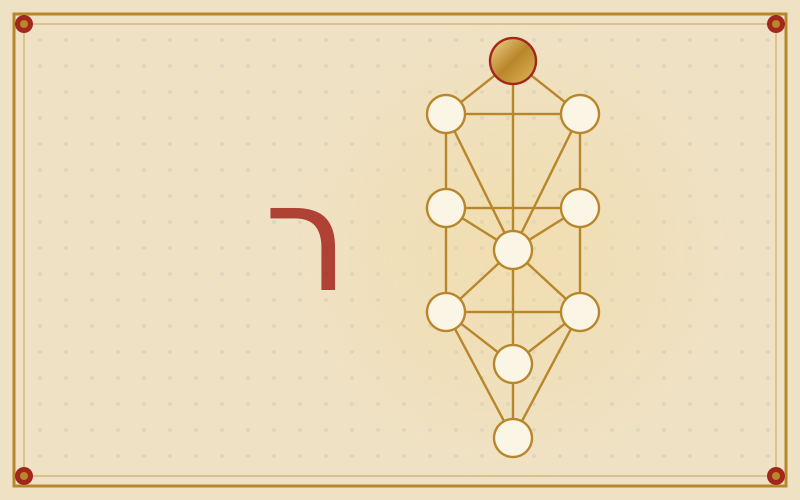
The ten sefirot are the stations of the Tree of Life. But a tree is not made of nodes alone: it needs branches to connect them. In the kabbalistic tradition these connections are the paths, in Hebrew netivot. In the most widespread diagram there are twenty-two of them, as many as the letters of the Hebrew alphabet, and each is associated with a letter.
The thirty-two ways of wisdom
The Sefer Yetzirah opens with a famous sentence: the world was created through thirty-two wondrous ways of wisdom. The text immediately explains what it means: the ten sefirot plus the twenty-two letters.
This is the foundation of the idea of the paths. The sefirot are the qualities or dimensions of reality; the letters are the tools, the channels, the forces that bring them into relation. The total is thirty-two: this is why in the Hermetic tradition the paths are often numbered from 11 to 32, leaving the numbers 1 to 10 to the sefirot.
It is worth knowing that the Sefer Yetzirah itself contains no diagram of the Tree: it speaks of sefirot and letters, but does not say which letter connects which spheres. The graphic schemes came later.
Three letters, seven, twelve
According to the Sefer Yetzirah, the twenty-two letters fall into three groups:
| Group | Number | Examples | Main correspondences |
|---|---|---|---|
| Mother letters | 3 | Aleph, Mem, Shin | air, water, fire |
| Double letters | 7 | Bet, Gimel, Dalet, Kaf, Pe, Resh, Tav | the seven traditional planets |
| Simple letters | 12 | He, Vav, Zayin and others | the twelve signs of the zodiac |
In the diagrams of the Tree this division is reflected in the geometry: in many diagrams the three mother letters occupy the three horizontal paths, the seven doubles the vertical paths and the twelve simples the diagonal ones. Not every scheme follows this rule, but it is a recurring criterion in the Jewish tradition.
Different schemes for the same Tree
One of the most common mistakes of those approaching Kabbalah is to believe there is only one Tree. In reality there are several arrangements, which differ both in how the paths are drawn and in how the letters are assigned.
Kircher's scheme
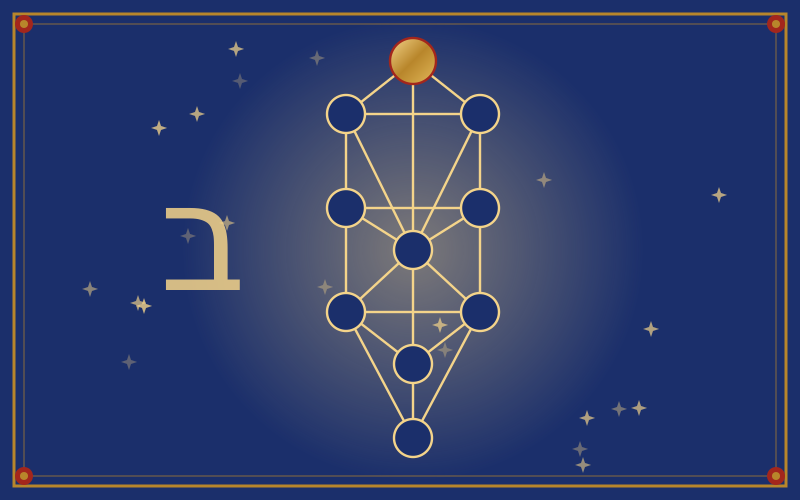
The diagram best known in the West today is linked to the work of the Jesuit Athanasius Kircher, a seventeenth-century scholar, who published a very widely circulated version. In this scheme the letters follow alphabetical order starting from the top: Aleph joins Kether to Chokmah, Bet joins Kether to Binah, Gimel joins Kether to Tiferet, and so on down to Tav, which joins Yesod to Malkuth.
It is the scheme adopted by the Western Hermetic tradition, which later linked the major arcana of the tarot to it.
The scheme of the Gaon of Vilna
In the Jewish tradition the scheme associated with the Gaon of Vilna, the great eighteenth-century Lithuanian master, is very important. Here the layout of the paths is partly different and the mother letters are placed consistently on the three horizontal paths.
The Lurianic scheme
In the school of Isaac Luria, too, there is an arrangement of its own, which in turn differs from the previous ones in some respects.
The practical consequence is clear: when a text states that a letter «belongs» to a certain path, you need to ask which scheme it refers to.
How to read a path
A path is not a mere stroke of the pen. The tradition interprets it as a passage of quality: what happens when the energy of one sefirah is transmitted to another. To understand a path, three elements are combined:
- the sefirah of departure;
- the sefirah of arrival;
- the letter that joins them, with its meaning, its shape and its numerical value.
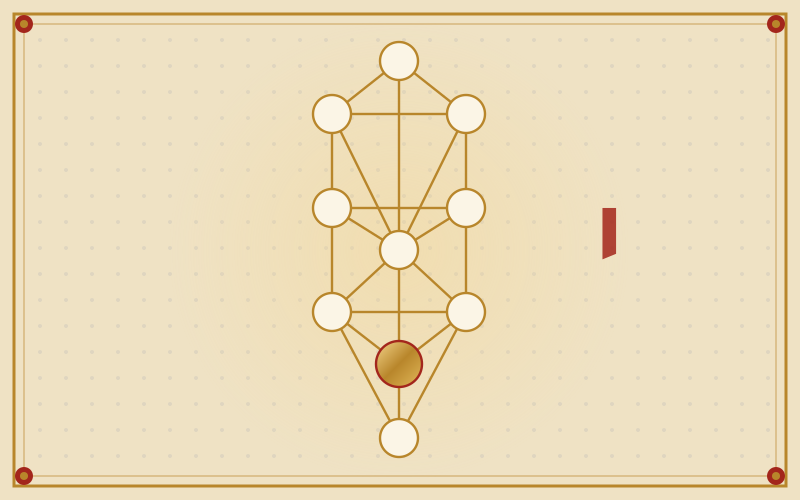
An example from Kircher's scheme: the path of Tav, which joins Yesod and Malkuth, is the last on the Tree. Tav is the last letter of the alphabet, and its name means «mark» or «seal». The path represents the passage from the world of images (Yesod) to the concrete world (Malkuth): the point where what has been imagined is «sealed» into reality.
The paths in inner work
In the modern Hermetic tradition the paths have also become itineraries of meditation. One chooses a path, studies its three components, and meditates on the passage it represents, often with the help of the image of the corresponding arcanum.
Studio Esoterico Cornelio suggests starting from the lowest paths, close to Malkuth, because they concern experiences that are easier to recognise in daily life, and climbing gradually. This is a path of study and reflection, not a system for obtaining results.
In short
- The paths are the connections between the sefirot, and in the most widespread scheme there are twenty-two.
- The Sefer Yetzirah speaks of thirty-two ways of wisdom: ten sefirot and twenty-two letters.
- The letters divide into three mothers, seven doubles and twelve simples.
- There are different schemes of the Tree, such as the one popularised by Kircher and the one of the Gaon of Vilna.
- A path is read by combining the sefirah of departure, the sefirah of arrival and the letter that joins them.