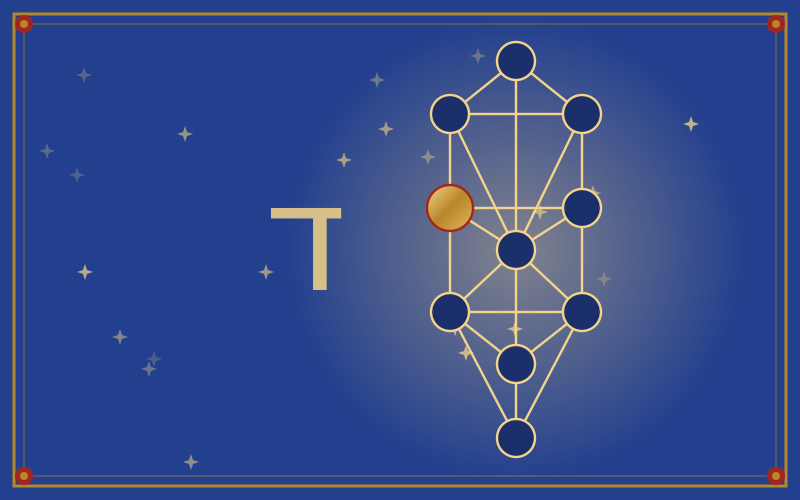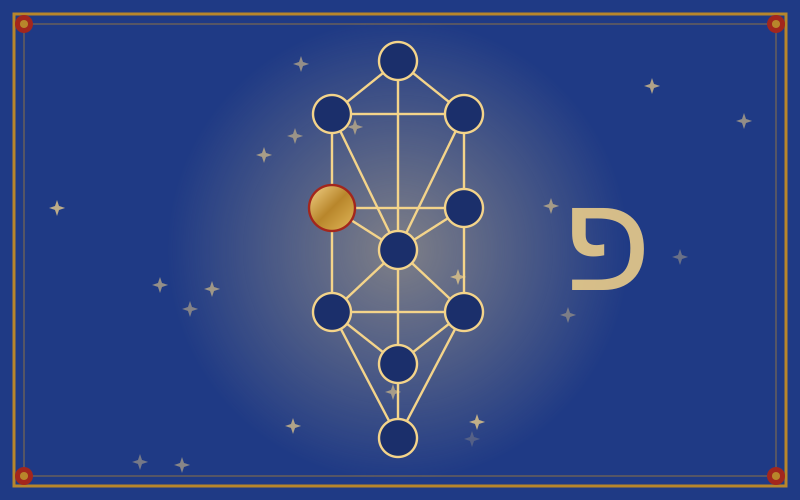
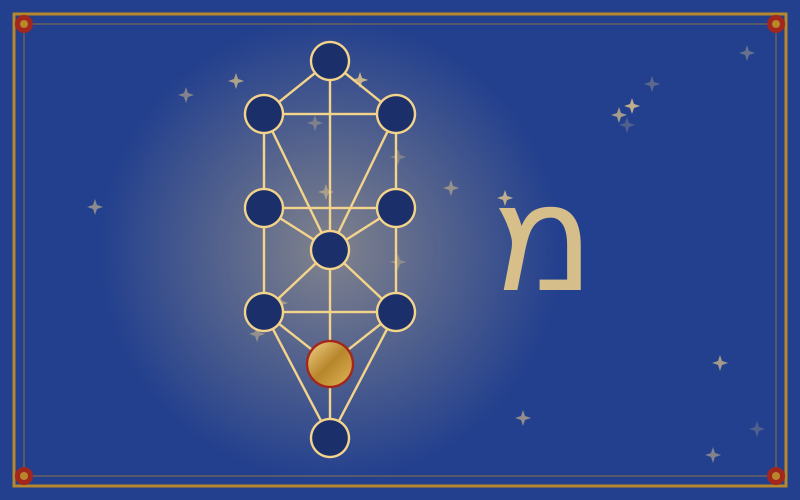
The ten sefirot of the Tree of Life are not arranged at random. In the most widespread diagram they line up along three vertical columns, called pillars. Even before studying each sefirah, understanding the three pillars lets you grasp the logic of the whole system: each sphere takes on meaning from the column it belongs to.
The arrangement
| Pillar | Sefirot | Quality |
|---|---|---|
| Right | Chokmah, Chesed, Netzach | Mercy, expansion |
| Middle | Kether, (Daat), Tiferet, Yesod, Malkuth | Balance, mediation |
| Left | Binah, Gevurah, Hod | Severity, contraction |
The right pillar gathers the sefirot that give, expand and open. The left pillar gathers those that receive, define and set limits. The middle pillar unites the sefirot that harmonise the two tendencies and allow energy to descend in a straight line from top to bottom.
An important point: graphic conventions vary. Some diagrams show the Tree as if you were looking at it from the front, others as if it were the body of the one who bears it, and in that case right and left appear reversed on the page. It is always worth checking which convention an author follows.
The pillar of Mercy
In traditional terminology the right pillar is also called the masculine or active pillar. Its three sefirot are:
- Chokmah, Wisdom, the flash of intuition;
- Chesed, Mercy, generosity that expands;
- Netzach, Victory, the force that endures.
What they share is outward movement. They represent energy that gives without calculating, life that grows.
The pillar of Severity
The left pillar is called the feminine or receptive pillar, but also the pillar of Severity or Judgement. Its three sefirot are:
- Binah, Understanding, which gives form;
- Gevurah, Severity, which sets limits;
- Hod, Splendour, which structures and names.
What they share is inward movement: containing, defining, distinguishing. Without this pillar the energy of the right would scatter.
The terms «masculine» and «feminine» should be understood in a symbolic and technical sense, as with yin and yang: they indicate two polarities present in every process, not qualities of real people.
The pillar of Balance
The middle pillar is the most important from the point of view of inner work. Kether, Tiferet, Yesod and Malkuth run along it, with Daat in the hidden space between Kether and Tiferet. Here the polarities meet and are reconciled.
The Hermetic tradition also calls it the pillar of Mildness or of Consciousness. In many modern meditative practices this pillar is imagined as a shining axis running through the body from the crown of the head to the feet, with the central sefirot placed along it. The exercise is Hermetic rather than Jewish in origin, but clearly inspired by the structure of the Tree.
The columns of the Temple: Jachin and Boaz
The First Book of Kings describes two bronze columns set at the entrance of Solomon's Temple, called Jachin and Boaz. Jachin means «he will establish», Boaz «in him is strength».
The Hermetic and Masonic traditions have linked the two columns to the side pillars of the Tree: Jachin to the pillar of Mercy, Boaz to the pillar of Severity. Between the two columns lies the door of the Temple, which corresponds to the middle pillar: passage is possible only in the middle, through balance.
It should be noted that the exact pairing of columns and pillars varies between authors: some reverse it. What remains constant is the idea of two opposing forces framing a central way.
Three pillars, three ways to go wrong
Reading the pillars as an inner map helps recognise three forms of imbalance:
- Excess of the right pillar: enthusiasm, generosity, drive, but without limits or concreteness. A great deal is begun and little is finished.
- Excess of the left pillar: order, discipline, critique, but without warmth or openness. Everything is controlled and little is lived.
- Retreating to the centre without crossing the sides: a false balance made of indifference. The authentic centre does not avoid the polarities; it integrates them.
This last point is often overlooked. The balance of Tiferet does not come from the absence of Chesed and Gevurah, but from their full presence.
A self-observation exercise
The Studio Esoterico Cornelio suggests choosing one area of your life, such as work or a relationship, and writing three short lists:
- the actions in which you give, open up, propose (right pillar);
- the actions in which you assess, limit, organise (left pillar);
- the actions in which you mediate between the two tendencies (middle pillar).
Comparing the lists shows which pillar prevails and where a change of course is needed.
In short
- The ten sefirot are arranged on three pillars: Mercy, Severity and Balance.
- The right pillar unites Chokmah, Chesed and Netzach; the left Binah, Gevurah and Hod.
- The middle pillar includes Kether, Tiferet, Yesod and Malkuth, with Daat hidden.
- The Hermetic tradition links the side pillars to the Temple columns Jachin and Boaz.
- As an inner map, the pillars help recognise imbalances and seek an authentic centre.