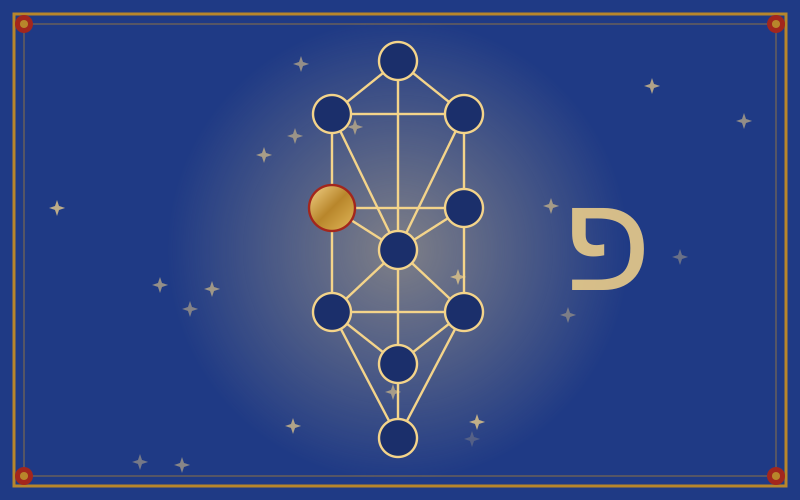
When people speak of Kabbalah they usually think of the Tree of Life, the sefirot, the Zohar. But in the thirteenth century, in the same years in which the Zohar was taking shape in Castile, another kabbalist was following a very different road. His name was Abraham Abulafia, and his interest was not so much in describing the structure of the divine as in experiencing its presence through a meditative discipline based on the letters.
A life on the move
Abulafia was born in Saragossa, in Aragon, in 1240. As a young man he set out for the Land of Israel, but the journey was soon interrupted. He then studied in Spain, where he devoted himself to the philosophy of Maimonides and to the Sefer Yetzirah: two sources that deeply marked his thought.
His life was marked by continual travel between Spain, Greece, Italy and Sicily. In 1280 he went to Rome intending to meet Pope Nicholas III, but the pontiff died before the meeting could take place. Abulafia was briefly detained and then released.
He then spent several years in Sicily, where he had disciples, and also stayed on the small island of Comino, in the Maltese archipelago, where he composed some of his works. His prophetic claims earned him the opposition of important rabbinic authorities, such as Solomon ibn Adret of Barcelona.
Two paths of Kabbalah
Modern scholars, in particular Moshe Idel, have proposed distinguishing two great currents in medieval Kabbalah:
| Current | Main interest | Example |
|---|---|---|
| Theosophical Kabbalah | the structure of the divine, the sefirot | the Zohar |
| Ecstatic Kabbalah | the experience of union, meditative technique | Abulafia |
The distinction is not rigid, but it helps to understand what makes Abulafia so particular. For him the sefirot were not the centre of the quest: the centre was the inner experience that the study of the letters could produce.
The science of combination
The heart of Abulafia's method is the chokhmat ha-tzeruf, the «science of the combination» of letters. Starting from the idea of the Sefer Yetzirah, according to which the world was created by combining the twenty-two letters, Abulafia proposes retracing that act in reverse: by combining the letters, the mind frees itself from the images of the sensible world and opens to a higher knowledge.
The procedure, described in his works, includes several elements:
- writing: the letters of a divine name are written and recombined according to precise rules, on tablets or sheets;
- pronunciation: each combination is pronounced, pairing the consonants with the different vowels;
- breath: pronunciation is regulated by a rhythm of inhalations and exhalations;
- head movements: each vowel corresponds to a direction in which to turn the head;
- concentration: everything takes place in a secluded spot, in silence, with the mind turned entirely to the exercise.
It is a discipline that recalls, in some respects, meditative techniques of other traditions, such as the repetition of sacred names or the regulation of breath.
The music of the letters
Abulafia compared the combination of letters to music. Just as a musician combines notes and produces different moods in the listener, so whoever combines letters produces an inner movement in his own soul. The letters are like notes, the vowels like rhythms, and the mind like an instrument that vibrates.
This image shows the deeply experiential character of his Kabbalah: it is not a matter of deciphering a code, but of letting oneself be transformed by the sound and shape of the letters.
The legacy
Abulafia's works, such as the Or ha-Sekhel («Light of the Intellect») and the Chayei ha-Olam ha-Ba («The Life of the World to Come»), circulated in manuscript and influenced later kabbalists, including in the Kabbalah of Safed. In Italy his work was also known in the circles of Renaissance Christian Kabbalah.
For a long time Abulafia remained a marginal figure in scholarship. It was above all in the twentieth century, with the research of Gershom Scholem and then of Moshe Idel, that his thought was rediscovered and studied carefully.
What he teaches those who study today
Abulafia's experience reminds us that Kabbalah is not only a system of symbols to be learned, but also a path of attention. Even without practising his full techniques, which require preparation and knowledge of Hebrew, one can grasp their spirit: slowing down, giving room to the sound and shape of the letters, letting the mind gather itself.
At Studio Esoterico Cornelio the figure of Abulafia is presented as an example of a lived Kabbalah, in which study becomes inner exercise and silence.
In short
- Abraham Abulafia was born in Saragossa in 1240 and lived between Spain, Italy, Sicily and Comino.
- He is the main exponent of ecstatic Kabbalah, distinct from the theosophical Kabbalah of the Zohar.
- His method is based on the combination of letters, pronunciation, breath and concentration.
- He compared the combination of letters to music, capable of moving the soul.
- Rediscovered in the twentieth century, he is now considered a central figure of Jewish mysticism.