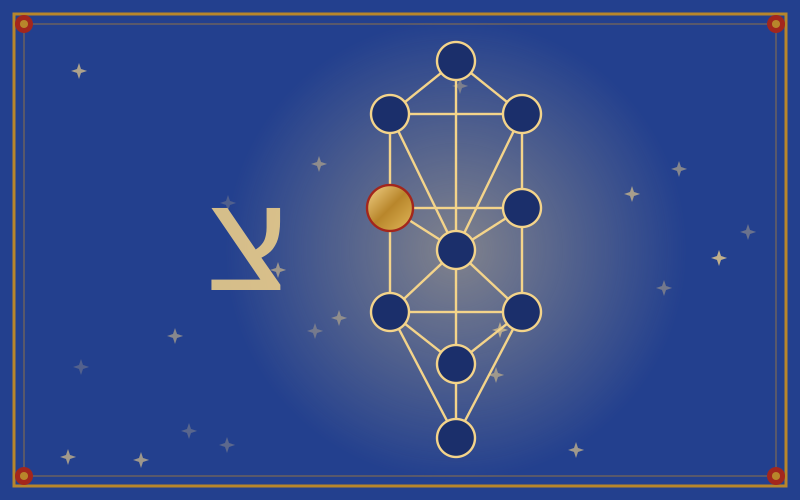
In the Jewish tradition a sacred text does not have just one meaning. It can be read on different levels, each legitimate and each deeper than the one before. The best-known way of expressing this idea is the word Pardes, which in Hebrew means «orchard» or «garden», and from which, through Persian and Greek, our word «paradise» also derives.
A garden and four letters
In the Middle Ages, in circles close to those in which the Zohar was born, the word PaRDeS came to be read as a notarikon, that is, an acrostic. Its four consonants become the initials of four ways of reading Scripture:
| Letter | Level | Meaning |
|---|---|---|
| P | Peshat | the plain, literal sense |
| R | Remez | the allusion, the symbolic sense |
| D | Derash | the inquiry, the interpretive and moral sense |
| S | Sod | the secret, the mystical sense |
The garden thus becomes the image of the text itself: one enters through the gate of the literal sense and advances, path after path, towards the hidden centre.
The four levels
Peshat: the plain sense
The peshat is the immediate meaning of the text, the one drawn from grammar, context and common sense. An ancient rule states that a verse never departs from its plain sense: however deep the interpretations, they cannot erase the literal meaning.
Remez: the allusion
The remez captures the hints, the allusions, the details that point to something else. The techniques that work on letters, such as gematria, also belong here: a number, an unusual word, a letter written in a particular way can «allude» to a further meaning.
Derash: interpretation
The derash is the field of midrash, the immense rabbinic literature of commentary. Here the text is questioned, compared with other passages, developed into stories and moral teachings. It is the level at which Scripture speaks to the life of the community.
Sod: the secret
The sod is the mystical level, that of Kabbalah. Here the characters, events and words of the Torah are read as symbols of the sefirot and of the divine life. The Zohar is the greatest example of reading according to sod.
An example: the garden of Eden
To understand how the four levels work, one can take the story of the garden of Eden:
- peshat: God plants a garden, places man in it, gives him a command;
- remez: the four rivers flowing out of the garden allude to four directions, four kingdoms, four ways of knowing;
- derash: the story teaches the value of limits, the responsibility of choice, the consequences of disobedience;
- sod: the garden is the Shekhinah, the river that waters it is the flow of the upper sefirot, the tree is the very structure of the Tree of Life.
None of these levels cancels the others. They are like the concentric rooms of the same house.
The four who entered the Pardes
The word Pardes is also linked to one of the most famous and mysterious stories of rabbinic literature, told in the Talmud. Four sages entered the Pardes: Ben Azzai, Ben Zoma, Elisha ben Abuya, called Acher, «the other», and Rabbi Akiva.
- Ben Azzai looked and died.
- Ben Zoma looked and was harmed, losing the balance of his mind.
- Acher «cut the shoots», that is, he turned away from the faith.
- Rabbi Akiva entered in peace and came out in peace.
The story has been interpreted as the description of a dangerous mystical experience, an ascent towards the heavenly realities that only those who are ready can face without harm. The same passage reports a warning attributed to Rabbi Akiva: when you reach the stones of pure marble, do not say «water, water». Many read in it an invitation not to be deceived by the appearances of visions.
The meaning of the story for those who study
The lesson of the story is clear even outside its historical frame: the study of the deepest levels requires solidity. Rabbi Akiva is the only one who comes out unharmed, and he is also the master most rooted in the study of peshat and derash. The secret is not reached by skipping the earlier levels, but by passing through them.
This is why Studio Esoterico Cornelio insists on the order of study: first the plain knowledge of texts and symbols, then the allusions, then the interpretations, and only finally the contemplation of hidden meanings. Those who start directly from sod risk building on unstable ground.
In short
- Pardes means «garden» and is used as an acrostic of the four levels of reading.
- Peshat is the literal sense, remez the allusion, derash the interpretation, sod the secret.
- No level cancels the others: the literal sense remains the foundation.
- In the Talmudic story, of the four sages who entered the Pardes only Rabbi Akiva came out in peace.
- The study of the deeper levels requires having passed through the earlier ones.