
Metatron is one of the most enigmatic figures in angelology. He does not appear in the Bible, he has no liturgical cult, and the origin of his very name remains uncertain. Yet in rabbinic literature and Jewish mysticism he holds a very high place, so high that for centuries he raised a delicate question: how close can a created being come to God?
A name without a Bible
Unlike Michael or Gabriel, Metatron has no direct roots in the biblical books. The name emerges in rabbinic tradition and in the texts of the so-called «Palaces» mysticism (Hekhalot). Its etymology has long been debated and no hypothesis has prevailed. The main proposals are:
- from the Greek meta thronon, «the one who stands beside the throne»;
- from the Latin metator, a term for someone who goes ahead and marks out the road, like a guide;
- from Hebrew roots linked to the idea of guarding or measuring.
The uncertainty is not a minor detail. A name that cannot be fully explained suits a figure living on the border between the human and the divine.
The mentions in the Talmud
The Babylonian Talmud names Metatron in only a few passages, but they are significant.
- In a passage of tractate Sanhedrin, a teacher connects Metatron with the verse of Exodus in which God says of the angel going before the people: «my name is in him». Metatron is therefore an angel whose name is like that of his Master.
- Tractate Chagigah tells of the four sages who entered the «orchard» (pardes), an image of mystical speculation. One of them, Elisha ben Abuyah, sees Metatron seated while writing down the merits of Israel. Since, it was thought, no one sits in heaven in God's presence, Elisha concludes that there are «two powers in heaven» and turns away from the faith. The story goes on to say that Metatron was punished with sixty lashes of fire, precisely to show that he is not a second deity.
- In tractate Avodah Zarah, Metatron appears as the one who teaches in heaven the children who died before they could study the Torah.
The Chagigah passage is the most important: it shows at once Metatron's greatness and the sages' concern not to make him a rival of God.
The Third Book of Enoch
The fullest source is a mystical text known as the Third Book of Enoch or Sefer Hekhalot. In it Rabbi Ishmael ascends through the heavenly palaces and meets Metatron, who reveals his own story: he was once Enoch, son of Jared, the man of whom Genesis says that he «walked with God, and he was not, for God took him».
According to the text, Enoch was taken up to heaven and transformed:
| Aspect | Description in the text |
|---|---|
| Body | his flesh becomes flame, his bones embers, his eyes lightning |
| Size | his stature grows until it fills the world |
| Garments | he receives a robe of glory and a crown |
| Name | he is called «the lesser YHWH» |
| Function | prince of the Presence, chief of the angels, heavenly scribe |
The title «lesser YHWH» is a bold one. The text itself, however, also tells the episode of Elisha ben Abuyah and Metatron's punishment, reaffirming the limit.
The scribe and the prince of the Presence
Across the various texts Metatron takes on recurring roles:
- Heavenly scribe: he records human deeds, in continuity with the figure of Enoch as scribe already found in the First Book of Enoch.
- Prince of the Presence: he stands directly before God, like the angels «of the Presence» of ancient Jewish tradition.
- Teacher: he instructs both angels and the souls of children.
- Intermediary: he is the point of contact between the upper and the lower world.
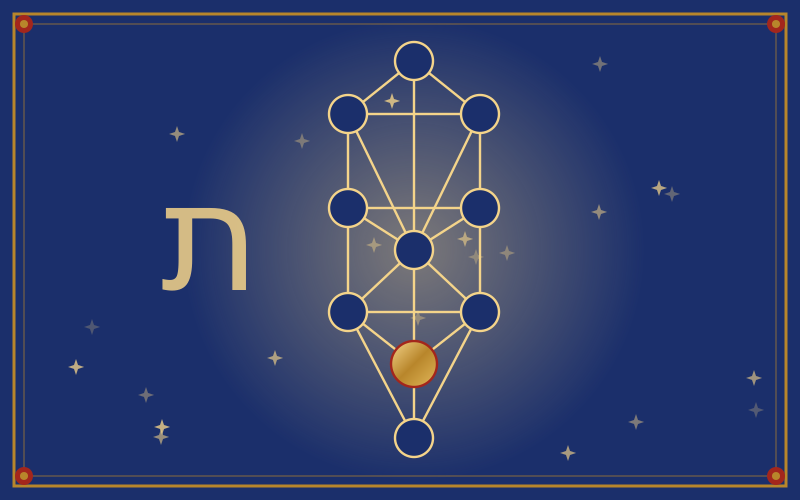
In later mysticism, including the Zohar, Metatron is sometimes called «the youth» (na'ar) and associated with the government of the created world. In the correspondences of modern Western esotericism he is often linked with the sefirah Kether, but this is a late construction.
The man who becomes an angel
What makes Metatron unique is the direction of the movement. In most traditions angels descend towards humanity; here a man ascends and becomes an angel. Enoch is not a heavenly being by nature: he becomes one through his «walking with God».
For the Studio Esoterico Cornelio this is the richest symbolic core. The story of Enoch-Metatron suggests that inner transformation is possible, and that it comes through everyday faithfulness rather than through some extraordinary feat. At the same time, Metatron's punishment in the Talmud is a reminder that no elevation should turn into a claim to omnipotence.
Some traditional keys of interpretation:
- walking with God as a constant discipline, not an isolated event;
- writing as a form of memory and responsibility;
- teaching the little ones as a task of the highest;
- the uncrossable boundary between creature and Creator.
In short
- Metatron does not appear in the Bible; the name emerges in rabbinic and mystical literature, with an uncertain etymology.
- The Talmud presents him as a very high angel but affirms his subordination through the story of Elisha ben Abuyah.
- The Third Book of Enoch identifies him with the patriarch Enoch, transformed into fire and called «the lesser YHWH».
- His main roles are heavenly scribe, prince of the Presence and teacher.
- Symbolically he represents human transformation through faithfulness, within a limit that must not be crossed.