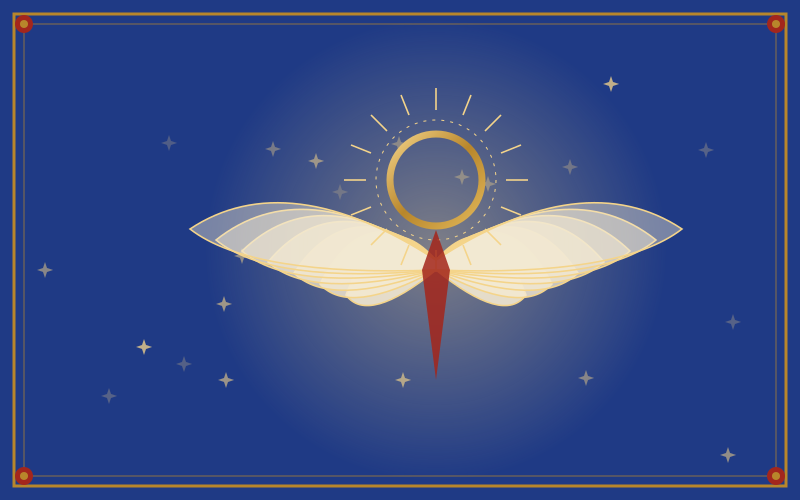
At the summit of the angelic hierarchy, in the Christian tradition that follows Pseudo-Dionysius, stand the Seraphim. They are the creatures closest to the divine throne, and they are also those of whom the Bible says least: a single passage names them explicitly as heavenly beings. Yet that passage, the sixth chapter of the book of Isaiah, was enough to make them one of the most powerful images in all of angelology.
The name: «those who burn»
The Hebrew term seraph (plural seraphim) is linked to the root s-r-p, meaning «to burn». The Seraphim are therefore, literally, «the burning ones». The same word, however, also appears in other biblical contexts with a different meaning: in the book of Numbers it denotes the venomous serpents that strike the people in the desert, and the bronze serpent raised by Moses is a saraph. Isaiah himself, in other passages, speaks of a «flying serpent».
This double use has fuelled many hypotheses. Some scholars have suggested that the original image was of winged serpent-like beings, perhaps related to the Egyptian iconography of the uraeus, the royal cobra. This is a debated hypothesis, not an established fact. What remains certain is the link between the name and fire.
Isaiah's vision
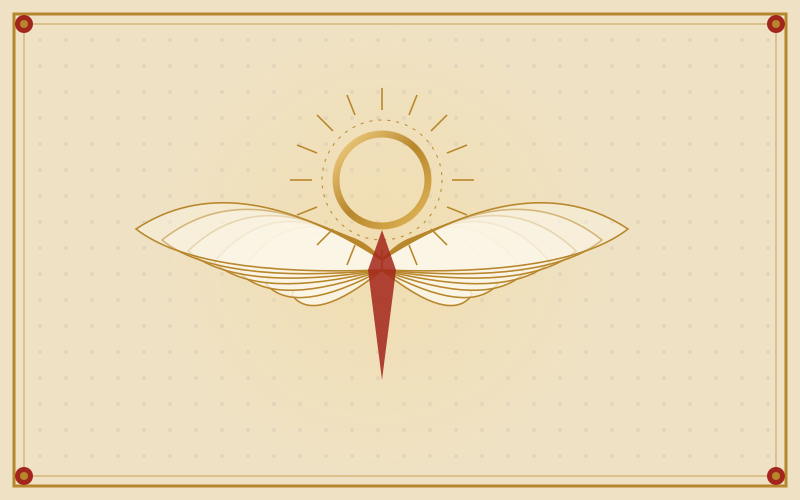
The account is brief and intense. In the year that King Uzziah died, the prophet sees the Lord seated on a throne, high and lifted up, the train of his robe filling the temple. Above him stand the Seraphim, each with six wings:
- with two they cover their faces;
- with two they cover their feet;
- with two they fly.
They call to one another: «Holy, holy, holy is the Lord of hosts; the whole earth is full of his glory». At the sound of that voice the doorposts shake and the temple fills with smoke.
The meaning of the six wings
Tradition has read the three pairs of wings as a teaching.
| Wings | Gesture | Symbolic reading |
|---|---|---|
| First pair | covering the face | reverence: not even the Seraph can bear the direct sight of glory |
| Second pair | covering the feet | humility and modesty of the creature |
| Third pair | flying | readiness to serve and to move toward God |
It is a paradoxical image: the highest creatures in the hierarchy are also those that veil themselves most. Nearness to the divine produces not pride but an even greater sense of distance and wonder.
The burning coal
Faced with the vision Isaiah cries out: «Woe is me, I am lost, for I am a man of unclean lips». Then one of the Seraphim flies to him holding a burning coal, taken with tongs from the altar, and touches his mouth, saying that his guilt is taken away. Only after this purification can the prophet answer the call: «Here am I, send me».
The scene already contains, in narrative form, the principle that Dionysius would place at the centre of his theology: the celestial hierarchy purifies, illuminates and brings to completion. The Seraph does not punish with fire, but uses it to make the man able to speak.
The Trisagion
The threefold «Holy» of the Seraphim entered the Jewish liturgy, in the Kedushah, and the Christian one, in the Sanctus of the Mass. The Trisagion of the Eastern liturgies, with the formula «Holy God, Holy Mighty, Holy Immortal», is a direct echo of it. Each time a community repeats those words, in the traditional perspective it joins the song of the Seraphim: the earthly liturgy becomes a reflection of the heavenly one.
The Seraphim in theology and mysticism
For Pseudo-Dionysius the very name reveals the nature of this choir: perpetual motion around God, warmth, the capacity to set the lower orders aflame and to dispel all darkness. Medieval theologians associated the Seraphim with love, while the Cherubim were linked to knowledge. This is why Francis of Assisi was called «the Seraphic»: according to the Franciscan sources, the stigmata were impressed on him during the vision of a crucified Seraph on Mount La Verna.
Fire as a symbol
In esoteric language fire is the element of transformation: it consumes what is impure and leaves what is essential. The Seraphim are its highest personification. From the perspective of Studio Esoterico Cornelio, meditating on them does not mean imagining flaming creatures, but recognising that all true knowledge passes through purification, like Isaiah's lips touched by the coal.
In short
- The name seraphim comes from a Hebrew root meaning «to burn»: they are «the burning ones».
- The only explicit biblical description is in chapter 6 of Isaiah, with their six wings and the threefold «Holy».
- The burning coal that purifies the prophet's lips expresses the purifying role of the celestial hierarchy.
- Their song lies at the origin of the Jewish Kedushah, the Sanctus and the Christian Trisagion.
- Symbolically they represent the fire that transforms and the love that draws near to the divine.