In Elizabethan England one of the most learned men in the kingdom, a mathematician, geographer and adviser to the queen, spent years seeking direct contact with the angels. His sessions, carefully recorded in journals, are one of the most singular documents in the history of European esotericism. From them arose the so-called Enochian system, destined for a long afterlife.
Who John Dee was
John Dee was a scholar of the first rank. He owned one of the richest private libraries in the England of his day, worked on mathematics, astronomy, navigation and cartography, and wrote a famous preface to the first English translation of Euclid's Elements. He was also close to the court of Elizabeth I, who consulted him on several occasions.
For Dee, knowledge of nature was not enough. He was convinced that the highest secrets could be learned only by revelation, as had happened, according to tradition, to the patriarch Enoch. Hence his desire to speak with the angels.
The seer Edward Kelley
Dee did not claim to see the angels himself. He relied on a medium, called a «scryer», who gazed into a shew-stone and reported what he saw and heard. After some attempts with other collaborators, from the early 1580s his main seer was Edward Kelley, a controversial figure about whom even contemporaries expressed suspicion.
The sessions followed a recurring pattern:
- an opening prayer by Dee;
- Kelley gazed into the stone and described the apparitions;
- Dee noted down every word, including letters dictated one by one;
- questions were asked, and the spirits answered.
The instruments
The sessions required objects carefully prepared according to the instructions received.
| Instrument | Description |
|---|---|
| Shew-stone | a crystal and an obsidian mirror, now kept in museum collections |
| Sigillum Dei | a large wax seal engraved with divine and angelic names |
| Holy table | the table on which the seals and the stone rested |
| Letter tables | grids of letters from which names and texts were derived |
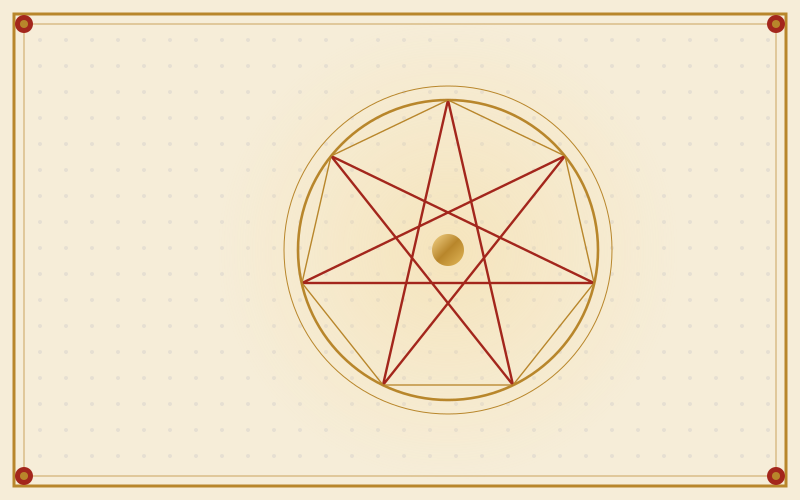
The Sigillum Dei, the «Seal of God», is a complex figure of circles, heptagons and stars bearing the names of angels. Wax examples associated with Dee have survived to this day.
The angels of the sessions
The journals feature well-known figures of tradition, such as Michael, Raphael and Uriel, together with new spirits. One of the most famous is Madimi, who appears as a little girl and seems to grow up over the years. The angels teach, rebuke, reveal and at times make disconcerting demands, which tested Dee's trust.
The Enochian language
The best-known fruit of the sessions is a language, called by the angels «the language of Adam» and today known as Enochian. It has its own alphabet of twenty-one letters, a grammar and a vocabulary.
In this language the Calls or angelic Keys were dictated, invocations in solemn prose which, according to the system, open access to different spiritual regions. One of the Calls, repeated with different names, serves for the thirty «Aethyrs», concentric heavens described in the sessions.
Many scholars have analysed the Enochian language. Some have seen similarities with English in its sentence structure; others have stressed the consistency of its vocabulary. The question of its origin remains debated.
The journey to Europe
In 1583 Dee and Kelley set out for Central Europe. They went to Poland and then to Bohemia, to the court of Emperor Rudolf II in Prague, famous for his interest in alchemy and the occult arts. The stay did not bring the hoped-for results, and relations between Dee and Kelley deteriorated. Dee returned to England, where he spent his last years in financial difficulty.
The posthumous fortune
After Dee's death, part of his journals was published in the seventeenth century by Méric Casaubon with the aim of showing that Dee had been deceived by evil spirits. Paradoxically, this publication made the Enochian system accessible to many readers. At the end of the nineteenth century the Hermetic Order of the Golden Dawn incorporated it into its teaching, and from there it spread into modern esotericism.
How to read it today
The Studio Esoterico Cornelio regards Dee's story above all as a chapter in the history of thought. Some lessons emerge clearly:
- the desire for total knowledge can lead even the clearest minds into uncertain territory;
- the quality of the intermediary matters as much as the intention of the seeker;
- Dee's scrupulous record-keeping still allows critical study today;
- discernment is necessary, above all when revelations ask one to cross moral limits.
In short
- John Dee, an Elizabethan scholar, sought for years a dialogue with the angels through a seer.
- The main seer was Edward Kelley, who gazed into a shew-stone during the sessions.
- Instruments such as the Sigillum Dei and the letter tables were prepared according to the instructions received.
- The sessions produced the Enochian language, with the Calls and the system of the thirty Aethyrs.
- Partly published by Casaubon, the journals inspired the Golden Dawn and modern esotericism.